
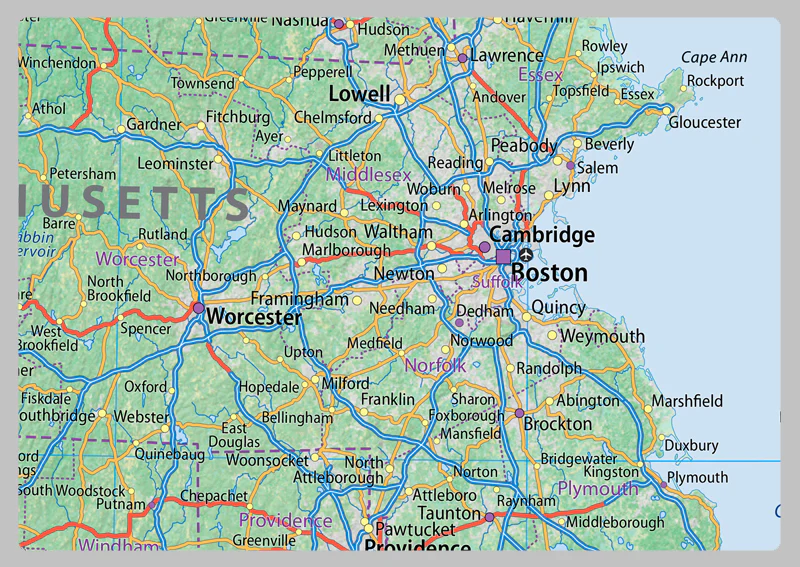
A New England states map answers a basic geographic question quickly: which states belong to New England and where are they located? In its simplest form, the map shows six states clustered in the northeastern corner of the United States Maine, New Hampshire, Vermont, Massachusetts, Rhode Island, and Connecticut. They sit east of New York, north of the Mid-Atlantic, bordered by Canada to the north and the Atlantic Ocean to the east.
But the map does far more than label boundaries. It explains why New England feels different from other American regions. The compact shapes, irregular borders, and dense concentration of towns reflect some of the earliest European settlement patterns in North America. Unlike regions formed through westward expansion, New England developed slowly, through charters, negotiations, and local governance.
Within the first glance, the map reveals a region defined by proximity. States are small, capitals are close together, and borders often follow rivers, mountains, or colonial agreements rather than straight survey lines. Understanding the New England states map means understanding how geography and history combined to produce a shared regional identity one that still influences politics, culture, and daily life today.
Where New England Fits on the U.S. Map
On a national map, New England occupies the upper-right corner of the continental United States. It is one of the smallest regions by land area but among the most densely settled. The Atlantic Ocean defines its eastern edge, shaping coastal economies and maritime traditions. Canada borders Maine to the north, giving the region an international boundary that influenced trade and security for centuries.
To the west, New York acts as a clear dividing line between New England and the Mid-Atlantic states. This boundary is cultural as much as geographic. While nearby regions expanded through large land grants and later settlement, New England’s borders stabilized early. The result is a map that feels compact and complete, with little ambiguity about what belongs inside the region.
The Six States That Define New England
| State | Capital | Geographic Character |
|---|---|---|
| Maine | Augusta | Forests, rocky coastline, northern border |
| New Hampshire | Concord | Mountains, lakes, river valleys |
| Vermont | Montpelier | Green Mountains, rural landscape |
| Massachusetts | Boston | Urban centers, historic coastline |
| Rhode Island | Providence | Compact size, maritime focus |
| Connecticut | Hartford | River systems, early industry |
Each state plays a distinct role on the map. Together, they form a balanced region of coast, mountains, cities, and countryside, all within a relatively small area.
Colonial History Embedded in the Map
The borders on a New England states map are a direct result of colonial-era decisions. English settlements established in the seventeenth century grew into separate colonies, each with its own charter and governing system. These early political divisions hardened into state boundaries after independence.
Massachusetts once included what is now Maine, explaining Maine’s later admission as a separate state. Vermont’s position reflects its unusual past as an independent republic before joining the Union. Rhode Island’s small size traces back to its origins as a refuge for religious dissenters rather than a large commercial colony.
Unlike later regions drawn with straight survey lines, New England’s borders reflect compromise and local control. The map preserves these early arrangements almost intact.
Physical Geography and Natural Boundaries
Natural features play a central role in shaping the New England map. Mountain ranges such as the White Mountains and the Green Mountains run north to south, influencing settlement patterns and transportation routes. Rivers, especially the Connecticut River, form natural borders and corridors that appear prominently on regional maps.
The coastline, deeply indented with bays and harbors, explains the early importance of fishing, shipping, and trade. Inland forests supported timber and small-scale farming. Climate, marked by cold winters and moderate summers, further influenced how towns developed and where people settled.
Taken together, these features show that the map is not arbitrary. It mirrors the land itself.
Economic Patterns Visible on the Map
The New England states map doubles as an economic guide. Coastal cities developed around ports and trade, while inland towns grew near rivers that powered mills and factories. Railroads and later highways followed these same geographic paths, reinforcing older patterns of movement and commerce.
Today, the map still reflects economic specialization. Urban corridors connect universities, hospitals, and technology centers across state lines. Rural areas retain agricultural and tourism-based economies. The close proximity of states supports regional labor markets and shared infrastructure, making the map a blueprint for cooperation.
Regional Identity and Cultural Meaning
New England’s shared map supports a strong regional identity. Accents, traditions, educational systems, and political attitudes often feel more regional than state-specific. Town-based governance, visible in dense municipal boundaries, reinforces local participation and civic responsibility.
Literature, journalism, and popular culture frequently treat New England as a single landscape, from coastal villages to mountain towns. The map provides the framework for this collective imagination, making the region recognizable and cohesive.
Modern Mapping and New Perspectives
While the outlines of the New England states have remained stable for centuries, modern mapping tools add new layers of understanding. Digital maps show population density, environmental risks, and transportation networks with clarity unimaginable to early mapmakers.
Issues such as coastal erosion, climate change, and urban growth become more visible when layered onto the familiar regional map. Yet even with advanced technology, the basic shapes remain the same, linking present challenges to historical geography.
Key Takeaways
- New England consists of six clearly defined northeastern states.
- The regional map reflects early colonial settlement and negotiation.
- Natural features strongly influenced borders and development.
- Economic patterns are closely tied to geography.
- A shared map reinforces regional identity.
- Modern mapping builds on centuries-old boundaries.
Conclusion
A New England states map is more than a visual aid. It is a historical document, a geographic explanation, and a cultural symbol. Its compact scale and irregular borders reveal how early decisions continue to shape modern life. The map shows a region formed not by expansion, but by continuity where towns, states, and identities grew side by side.
In studying this map, readers see how geography anchors history and how boundaries, once drawn, can endure for generations. New England’s influence on American culture, politics, and education begins with this small but powerful corner of the map.
FAQs
How many states are in New England?
There are six states in the New England region.
Which state is largest by area?
Maine is the largest New England state.
Why are New England states small?
Their borders were set early during colonial times and remained mostly unchanged.
Is New England officially defined by the government?
It is a recognized cultural and historical region, not a formal administrative one.
Why is New England culturally unified?
Shared history, geography, and early settlement patterns shaped a common identity.
APA References
Encyclopaedia Britannica. (n.d.). New England. Encyclopaedia Britannica. Retrieved December 2025, from https://www.britannica.com/place/New-England Encyclopedia Britannica
Hale, N. (1849). A map of the New England states, Maine, New Hampshire, Vermont, Massachusetts, Rhode Island & Connecticut with the adjacent parts of New York & Lower Canada; compiled and published by Nathan Hale, Boston [Map]. Library of Congress. Retrieved from https://www.loc.gov/item/98688378/ The Library of Congress
New England Region Map (2025). New Hampshire Region Map. Retrieved from https://www.newhampshiremap.com/new-england-region-map/ newhampshiremap.com
Ultimaps. (2025). Map of New England States. Retrieved from https://www.ultimaps.com/vector-maps/america/united-states-new-england-states/ Ultimaps
New England Definition & Meaning. (2025). Britannica Dictionary. Retrieved from https://www.britannica.com/dictionary/New-England Encyclopedia Britannica
Rhode Island. (2025). Rhode Island. Retrieved from https://en.wikipedia.org/wiki/Rhode_Island Wikipedia
)