
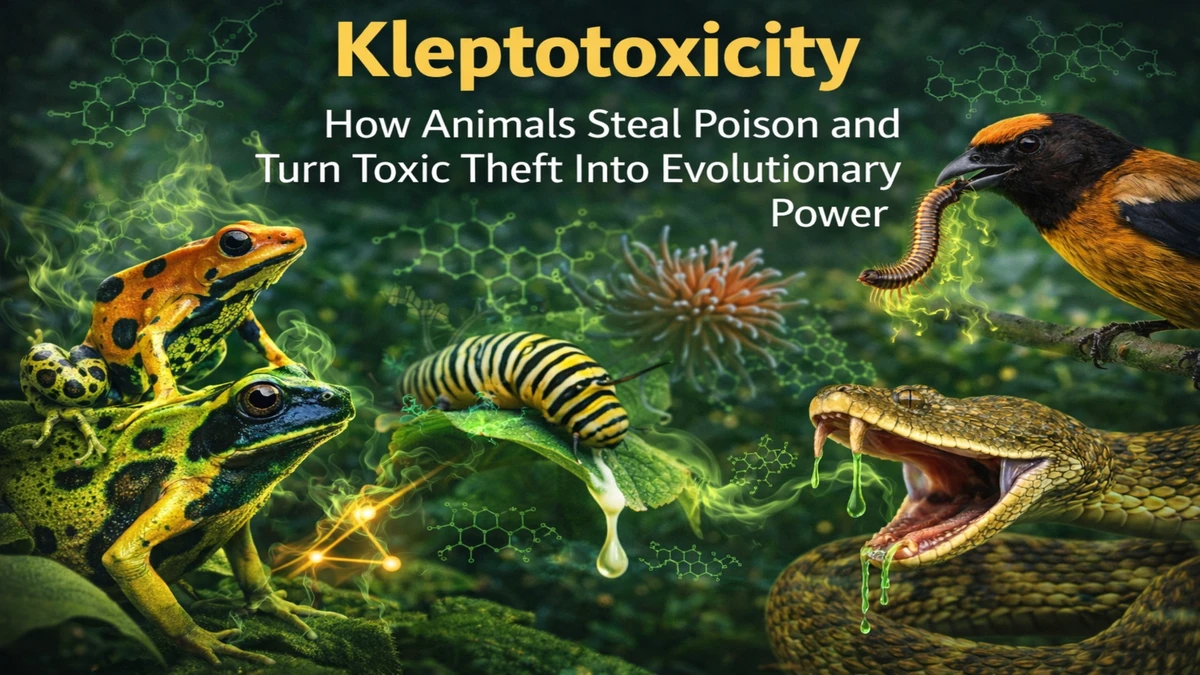
Kleptotoxicity is a scientific concept that sounds arcane until its implications become impossible to ignore. At its core, kleptotoxicity describes a survival strategy in which an organism acquires toxic chemicals from another species rather than producing them internally. Within the first moments of encountering the term, the reader’s intent is clear: kleptotoxicity explains how animals steal poison and turn it into protection.
This phenomenon challenges a long-standing assumption in biology that defensive toxins must be self-made. Instead, kleptotoxicity shows that evolution often favors efficiency over independence. If potent toxins already exist in the environment, some organisms evolve the capacity to absorb, tolerate, and redeploy them. This strategy has been documented across insects, amphibians, marine organisms, and vertebrates, revealing that toxin theft is not a rare curiosity but a recurring solution to predation pressure.
More broadly, kleptotoxicity forces a rethinking of how ecosystems function. Toxins become shared resources rather than isolated traits, linking species together through invisible chemical pathways. In a time when biodiversity loss threatens not only species but relationships between them, kleptotoxicity offers a striking reminder that survival often depends on ecological interdependence rather than self-sufficiency.
Defining Kleptotoxicity in Biological Terms
The term kleptotoxicity combines the Greek words for thief and poison, capturing the essence of the strategy with precision. Biologically, it refers to the sequestration of toxic compounds from dietary or environmental sources and their use as a defensive mechanism. Unlike venomous organisms, which inject toxins they synthesize, or poisonous organisms, which internally produce harmful chemicals, kleptotoxic species rely entirely on external sources.
This distinction is critical. Stolen toxins are often chemically complex and metabolically expensive to produce. By outsourcing toxin production, kleptotoxic organisms conserve energy and genetic resources. The toxins are typically stored in skin, glands, or specialized tissues, where they deter predators through taste, odor, or physiological damage.
Kleptotoxicity is not accidental ingestion. It requires evolved physiological systems that prevent self-poisoning. Resistance to toxins, specialized transport proteins, and controlled storage mechanisms all form part of this adaptive package, making kleptotoxicity a deeply integrated evolutionary trait.
The Emergence of Kleptotoxicity as a Scientific Concept
For centuries, naturalists suspected that some animals derived their toxicity from what they ate. However, kleptotoxicity became a formal scientific concept only in the late twentieth century, when chemical analyses provided definitive evidence. One pivotal moment came when researchers discovered that certain brightly colored frogs lost their toxicity in captivity when fed non-toxic diets.
This finding overturned assumptions about innate poison production. Subsequent studies traced frog toxins to specific prey species, particularly ants and mites rich in alkaloids. These discoveries reshaped chemical ecology and prompted scientists to look for similar patterns elsewhere.
Over time, kleptotoxicity was identified in butterflies that feed on toxic plants, beetles that sequester plant chemicals, and marine organisms that appropriate toxins from prey. What began as an anomaly became recognized as a widespread evolutionary strategy.
The Chemistry Behind Stolen Poisons
At the chemical level, kleptotoxicity is an exercise in precision. Not all toxins are suitable for sequestration, and not all organisms can tolerate them. Successful kleptotoxic species selectively absorb compounds that are stable, potent, and compatible with their physiology.
Many stolen toxins belong to chemical families such as alkaloids, terpenoids, or cardiac glycosides. Once ingested, these molecules are transported and stored in ways that isolate them from sensitive tissues. In some cases, organisms modify the toxins slightly to improve storage efficiency without reducing toxicity.
The result is a biological paradox: an animal that may appear harmless can be chemically dangerous, not because of what it produces, but because of what it appropriates.
Iconic Examples of Kleptotoxicity
Kleptotoxicity appears across diverse ecosystems, particularly where chemical diversity is high.
| Organism | Source of Toxin | Defensive Effect |
|---|---|---|
| Poison dart frogs | Ants and mites | Toxic skin secretions |
| Monarch butterflies | Milkweed plants | Predator deterrence |
| Leaf beetles | Host plants | Defensive exudates |
| Nudibranch sea slugs | Sponges and cnidarians | Chemical and stinging defenses |
These cases demonstrate that kleptotoxicity is not confined to a single lineage. It emerges wherever ecological conditions make toxin theft more advantageous than toxin synthesis.
Evolutionary Advantages and Expert Perspectives
Evolutionary biologists often describe kleptotoxicity as a form of chemical efficiency. One expert has characterized it as an evolutionary shortcut that reduces metabolic cost while maintaining strong defensive capabilities. This reframing positions kleptotoxicity as a rational response to environmental pressures rather than an evolutionary oddity.
Another expert perspective emphasizes coevolution. Predators that encounter toxic prey learn to avoid specific colors, patterns, or behaviors. Over generations, kleptotoxic species often evolve warning coloration that advertises their chemical defenses, reinforcing predator learning.
A third viewpoint highlights ecological dependency. Kleptotoxicity can only persist where toxic prey or plants remain available, tying the fate of kleptotoxic species to the health of their ecosystems.
Distinguishing Kleptotoxicity From Related Strategies
Kleptotoxicity is often conflated with other defensive mechanisms, but clear differences exist.
| Strategy | Toxin Origin | Purpose |
|---|---|---|
| Venom | Internally produced | Active defense or predation |
| Poison | Internally produced | Passive defense |
| Kleptotoxicity | Externally acquired | Passive defense |
| Camouflage | None | Avoidance |
This comparison highlights why kleptotoxicity deserves separate recognition. It is neither purely chemical production nor purely behavioral avoidance, but a hybrid strategy dependent on ecological opportunity.
Ecological Impacts and Food Web Dynamics
Kleptotoxicity creates chemical linkages across food webs. When one species relies on another for toxins, changes in population dynamics can ripple through ecosystems. A decline in toxic plants or insects can render kleptotoxic predators vulnerable, even if their own numbers initially remain stable.
These dependencies mean that kleptotoxicity amplifies the importance of biodiversity. Chemical resources function like ecological currencies, circulating through trophic levels and influencing predator-prey relationships. As habitats change due to climate or human activity, these chemical networks can unravel with unforeseen consequences.
Implications for Human Science and Innovation
Kleptotoxicity has implications beyond ecology. Many stolen toxins possess pharmacological properties, attracting interest from medical researchers. Understanding how animals tolerate and store toxic compounds can inform drug delivery systems and resistance mechanisms.
Some scientists suggest that studying kleptotoxic organisms could inspire safer ways to handle potent chemicals in medicine or industry. By mimicking biological storage and transport strategies, researchers may reduce collateral damage associated with toxic compounds.
Ethical and Conservation Considerations
The existence of kleptotoxicity underscores the fragility of ecological relationships. When environments are simplified or degraded, the chemical interactions that support toxin theft may disappear. Kleptotoxic species can lose their defenses without any visible change in behavior or appearance, making them particularly vulnerable to environmental disruption.
From an ethical perspective, kleptotoxicity reinforces the idea that conservation must protect relationships, not just species. Preserving ecosystems means preserving the chemical dialogues that allow organisms to survive.
Takeaways
- Kleptotoxicity involves acquiring toxins from other species rather than producing them
- It represents an efficient and evolutionarily stable defense strategy
- Specialized physiological resistance is essential for toxin sequestration
- The strategy links species together through shared chemical resources
- Ecosystem disruption can undermine kleptotoxic defenses
- Kleptotoxicity offers insights for medicine and bio-inspired design
Conclusion
Kleptotoxicity reveals a version of nature that is pragmatic, interconnected, and surprisingly economical. It shows that survival does not always depend on producing more, but on using what already exists with precision. By turning borrowed danger into protection, kleptotoxic organisms illustrate how evolution rewards adaptability over independence.
As research continues to uncover new examples of toxin theft, kleptotoxicity reshapes our understanding of defense, dependency, and resilience. It reminds us that the most powerful forces in nature are often invisible—molecules quietly moving through food webs, shaping lives and ecosystems alike.
FAQs
What is kleptotoxicity?
Kleptotoxicity is a biological strategy where organisms obtain toxins from other species for defense.
How does kleptotoxicity differ from being poisonous?
Poisonous organisms produce their own toxins, while kleptotoxic organisms acquire them externally.
Is kleptotoxicity common?
It is more widespread than once believed, especially in chemically rich ecosystems.
Do kleptotoxic animals harm themselves?
No, they evolve resistance mechanisms that allow safe storage of toxins.
Why is kleptotoxicity important to science?
It informs ecology, evolution, pharmacology, and conservation biology.
References
- Saporito, R. A., Donnelly, M. A., Norton, R. A., Garraffo, H. M., Spande, T. F., & Daly, J. W. (2007). Oribatid mites as a major dietary source for alkaloids in poison frogs. Proceedings of the National Academy of Sciences of the United States of America. https://www.pnas.org/content/104/21/8885 (Discusses how poison frogs sequester dietary alkaloids from arthropods) PMC
- Handwerk, B. (2024, June 12). A poisonous diet gives these animals their own toxic defense. Smithsonian Magazine. https://www.smithsonianmag.com/science-nature/a-poisonous-diet-gives-these-animals-their-own-toxic-defense-180984435/ (Profiles monarch butterflies, poison frogs, and other animals that sequester dietary toxins) Smithsonian Magazine
- Tarvin, R. D., et al. (2024). Passive accumulation of alkaloids in inconspicuously defended dendrobatid poison frogs. eLife. https://elifesciences.org/articles/100011 (Examines molecular mechanisms of toxin sequestration in poison frogs) eLife
- Santos, J. C., Coloma, L. A., & Cannatella, D. C. (2003). Multiple, recurring origins of aposematism and diet specialization in poison frogs. Proceedings of the National Academy of Sciences of the United States of America, 100(22), 12792–12797. https://www.pnas.org/doi/10.1073/pnas.2133521100 (Reviews evolutionary patterns in toxin sequestration and warning coloration) PNAS
- Oxford University Museum of Natural History. (2025). Toxic birds and chemical defense: how pitohui birds and others sequester poison. Science. https://en.wikipedia.org/wiki/Toxic_bird (Summarizes toxin sequestration in birds such as pitohui species) Wikipedia