
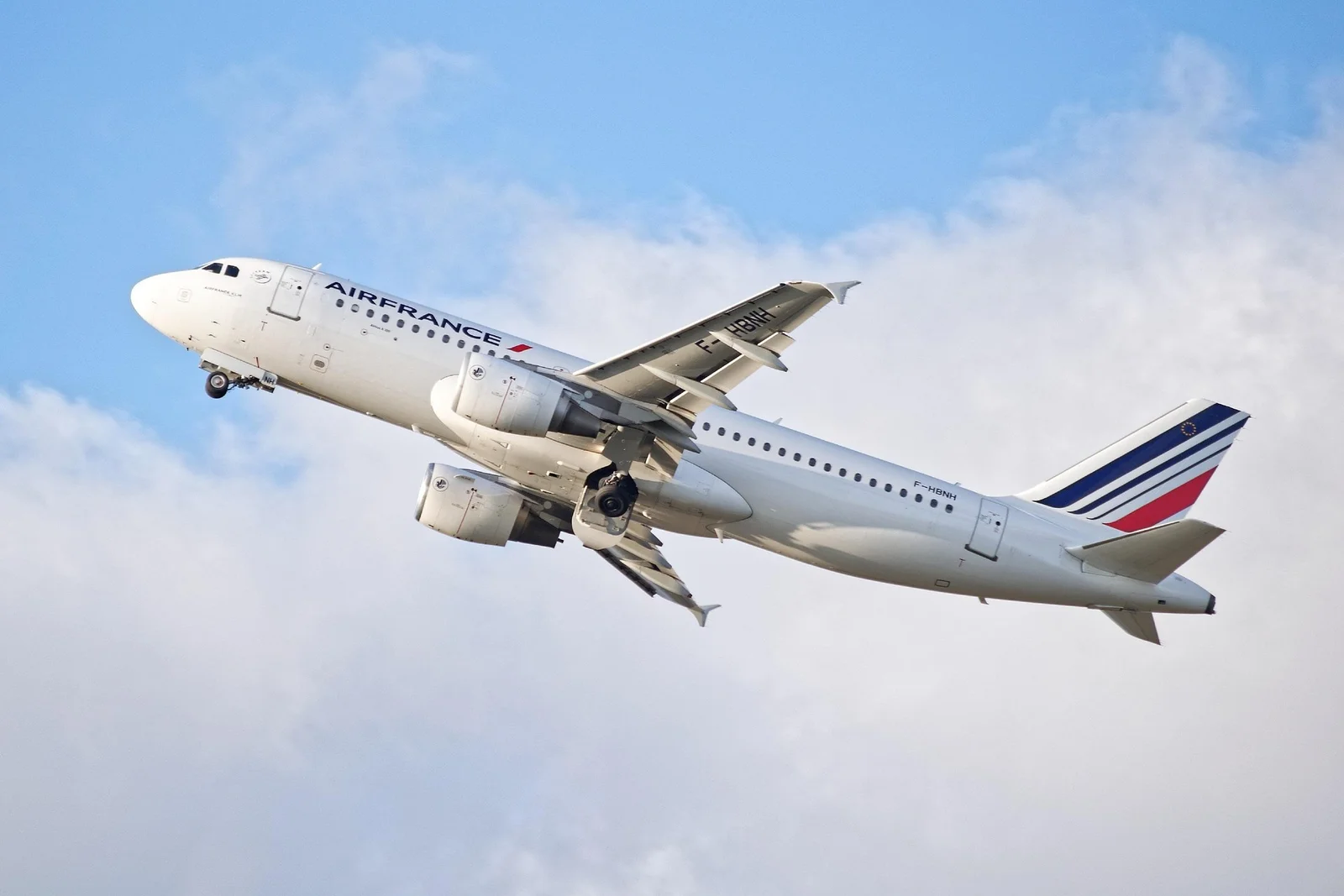
On a summer afternoon in late June 2025, Air France Flight AF136 lifted off from Paris–Charles de Gaulle Airport with the quiet confidence of routine. The Airbus A350-900, one of the airline’s newest long-haul workhorses, was scheduled to land at Chicago O’Hare International Airport before mid-afternoon local time. For passengers, it was a familiar transatlantic crossing: meals served, cabin lights dimmed, the slow rhythm of hours passing over the Atlantic.What unfolded instead was a rarity in commercial aviation. After more than six hours in the air, with North America drawing closer, the aircraft turned back. The destination disappeared from the flight map. Paris returned as the endpoint.
Within hours, Air France described the decision as the result of “operational reasons.” Subsequent reporting and aviation analysis clarified the core issue: the flight no longer held valid landing clearance for Chicago O’Hare. In an era when flights are tracked by satellite and guided by advanced automation, a lapse in regulatory authorization, not weather or mechanics, was enough to reverse an intercontinental journey.
The incident drew attention because it was unusual, but also because it was instructive. It exposed how international aviation depends on an intricate framework of permissions, time windows, and coordination among airlines, airports, and government agencies. The Air France A350’s return to Paris was not a failure of technology. It was a demonstration of how strictly the global aviation system adheres to rules designed to manage safety, security, and congestion at the world’s busiest airports.
The Flight and the Turnaround
Air France Flight AF136 departed Paris on schedule, operating a standard westbound route toward the American Midwest. The Airbus A350-900 climbed smoothly to cruising altitude and followed a northern Atlantic track, a common routing designed to optimize winds and fuel efficiency. Several hours into the flight, while still over oceanic airspace, the crew received confirmation that the aircraft would not be cleared to land at Chicago O’Hare within its approved arrival window. Under U.S. regulations, international flights must arrive within a narrowly defined timeframe linked to advance customs and border clearance filings. If a flight falls outside that window, its authorization effectively expires.
Rather than diverting to another U.S. airport, Air France elected to return to Paris. The decision balanced fuel calculations, crew duty limits, and passenger handling considerations. The A350 landed back at Charles de Gaulle after more than six hours airborne, completing an unusual loop that underscored the operational conservatism built into airline decision-making. For passengers, the experience was disorienting. For aviation professionals, it was a case study in compliance.
Why Landing Clearance Is Non-Negotiable
International aviation operates under a layered regulatory system. Airlines must satisfy the requirements of their home country, the destination country, and international agreements coordinated through organizations such as the International Civil Aviation Organization (ICAO).In the United States, Customs and Border Protection oversees international arrivals. Airlines submit detailed advance passenger information, crew data, and projected arrival times well before departure. These filings are tied to airport slot allocations, particularly at heavily congested hubs like Chicago O’Hare.
Once a clearance window is missed, it cannot simply be adjusted mid-flight. Allowing ad hoc changes would undermine traffic management and border security processes that rely on predictability. From a regulatory standpoint, denying landing permission is not punitive; it is procedural. An aviation policy analyst familiar with U.S. airport operations explains it this way: “Landing clearance is treated with the same seriousness as airworthiness. Without it, the aircraft might be physically capable of landing, but legally it cannot.”
Chicago O’Hare and the Pressure of Volume
Chicago O’Hare is among the busiest airports in the world by aircraft movements. It functions as a hub for domestic connections while also handling a steady flow of international arrivals. This dual role leaves little flexibility. Arrival slots are planned minute by minute. International flights must align not only with runway availability but also with customs staffing, gate assignments, and security screening capacity. When one element slips, the entire system is affected.
The Air France incident illustrates how even flagship international carriers operate within constraints that leave minimal room for improvisation. O’Hare’s scale amplifies the consequences of timing discrepancies that might be absorbed more easily at smaller airports.
The Airbus A350-900 in Context
The aircraft involved in the incident was the Airbus A350-900, a wide-body jet introduced as part of a new generation of long-haul airplanes. Air France has invested heavily in the A350 to replace older aircraft and reduce fuel burn and emissions. The A350’s capabilities were not in question during the AF136 flight. With advanced avionics, long-range endurance, and high fuel efficiency, it was well equipped to return safely to Paris once the decision was made.
Its role in this incident highlights a paradox of modern aviation: as aircraft become more technologically sophisticated, the limiting factors increasingly lie in regulatory and administrative domains rather than mechanical ones.
Air France’s Transatlantic Strategy
The Paris–Chicago route is a key component of Air France’s North American network. It connects the airline’s primary hub with a major U.S. gateway, supporting both business travel and onward connections. Typically, the route operates daily, with westbound flights scheduled to arrive in the early afternoon to maximize connectivity within the United States. The deployment of the A350 reflects Air France’s emphasis on efficiency and passenger comfort on long-haul services.
Below is a simplified overview of the route’s standard operating profile:
| Route | Typical Aircraft | Average Duration | Frequency |
|---|---|---|---|
| Paris (CDG) – Chicago (ORD) | Airbus A350-900 | ~9 hours westbound | Daily |
| Chicago (ORD) – Paris (CDG) | Airbus A350-900 | ~8 hours eastbound | Daily |
This consistency makes the turnaround of AF136 particularly notable. The route itself is mature and well understood. The disruption did not stem from unfamiliarity, but from the rigidity of compliance requirements.
Passenger Care and Airline Responsibility
When a flight returns to its origin after several hours in the air, the airline’s obligations shift from transport to care. European Union regulations require carriers to provide accommodation, meals, and rebooking options in the event of significant delays or cancellations, regardless of cause. Air France arranged overnight accommodations and placed passengers on a replacement flight the following day. While such measures do not erase the inconvenience, they reflect the standardized response framework airlines use to manage disruptions.
From a passenger rights perspective, incidents like this also raise questions about compensation eligibility. Because the return was driven by regulatory compliance rather than a technical fault, compensation assessments can vary depending on interpretation.
Expert Perspectives on Rare Turnarounds
Aviation professionals note that mid-ocean returns are uncommon precisely because they are disruptive and costly. Fuel burn, crew scheduling, and aircraft utilization all suffer when a long-haul flight fails to reach its destination. A former airline operations manager explains: “Turning back is always a last resort. But when clearance is gone, the decision becomes straightforward. The aircraft cannot legally land, and no airline will gamble on regulatory violations.”
Another expert in airport management emphasizes the systemic view: “People tend to see these events as airline mistakes. In reality, they are symptoms of how tightly the system is controlled. One missed window can ripple across continents.”
Comparing Causes of Transatlantic Turnbacks
Not all mid-flight returns share the same origins. Mechanical issues, medical emergencies, and weather diversions account for most cases. Regulatory denials, by contrast, are rare.
| Primary Cause | Frequency | Typical Response |
|---|---|---|
| Mechanical issue | Occasional | Diversion or return |
| Medical emergency | Occasional | Diversion to nearest airport |
| Severe weather | Periodic | Delay or diversion |
| Regulatory clearance issue | Rare | Return to origin |
The AF136 incident falls squarely into the rarest category, making it notable for aviation observers.
What the Incident Reveals About Modern Aviation
The return of Air France Flight AF136 illustrates a broader truth: aviation is as much about governance as it is about engineering. Flights operate within a dense web of agreements that prioritize safety, security, and predictability over flexibility. For airlines, this means investing not only in aircraft and crews but also in compliance systems that track permissions with near-perfect accuracy. For passengers, it means understanding that even the most advanced aircraft are subject to rules that can abruptly change a journey’s course.
Takeaways
- The Air France A350 return was caused by a loss of valid landing clearance, not technical failure.
- U.S. international arrival rules enforce strict timing and documentation requirements.
- Chicago O’Hare’s congestion leaves little flexibility for late or misaligned arrivals.
- Modern aircraft reliability shifts risk toward regulatory and administrative factors.
- Airlines prioritize legal compliance over schedule completion.
- Passenger care obligations activate immediately after such disruptions.
Conclusion
The mid-Atlantic return of an Air France A350 bound for Chicago was not a dramatic failure, but a quiet assertion of how modern aviation works. It demonstrated that in a system designed to move millions safely across borders, rules matter as much as runways. For passengers, the experience was an unexpected interruption. For the industry, it was a reminder that compliance frameworks are the invisible architecture supporting global mobility. As aircraft grow more capable and routes more crowded, the precision of permissions and timing will only become more critical.
In that sense, Flight AF136 did more than return to Paris. It offered a rare glimpse into the disciplined, sometimes unforgiving order that keeps international aviation functioning day after day.
Frequently Asked Questions
Why did the Air France A350 return instead of diverting to another U.S. airport?
Without valid U.S. landing clearance, diverting to another American airport would not resolve the regulatory issue.
Was the aircraft experiencing mechanical problems?
No mechanical or safety issues were reported with the Airbus A350-900.
Is this type of incident common?
Returns due to regulatory clearance issues are rare compared with weather or medical diversions.
Did passengers receive assistance?
Yes. Air France provided accommodation, meals, and rebooking on a later flight.
Does this affect Air France’s Chicago service long-term?
No. The route continues to operate as a core part of Air France’s transatlantic network.
References
Airbus. (2023). A350-900 technical characteristics and operational range. https://www.airbus.com
Air France. (2024). Fleet and long-haul network overview. https://www.airfrance.com
Federal Aviation Administration. (2023). Airport slot management and international arrival procedures. https://www.faa.gov
International Civil Aviation Organization. (2022). Convention on International Civil Aviation and annexes. https://www.icao.int
U.S. Customs and Border Protection. (2023). Advance passenger information systems and arrival requirements. https://www.cbp.gov