
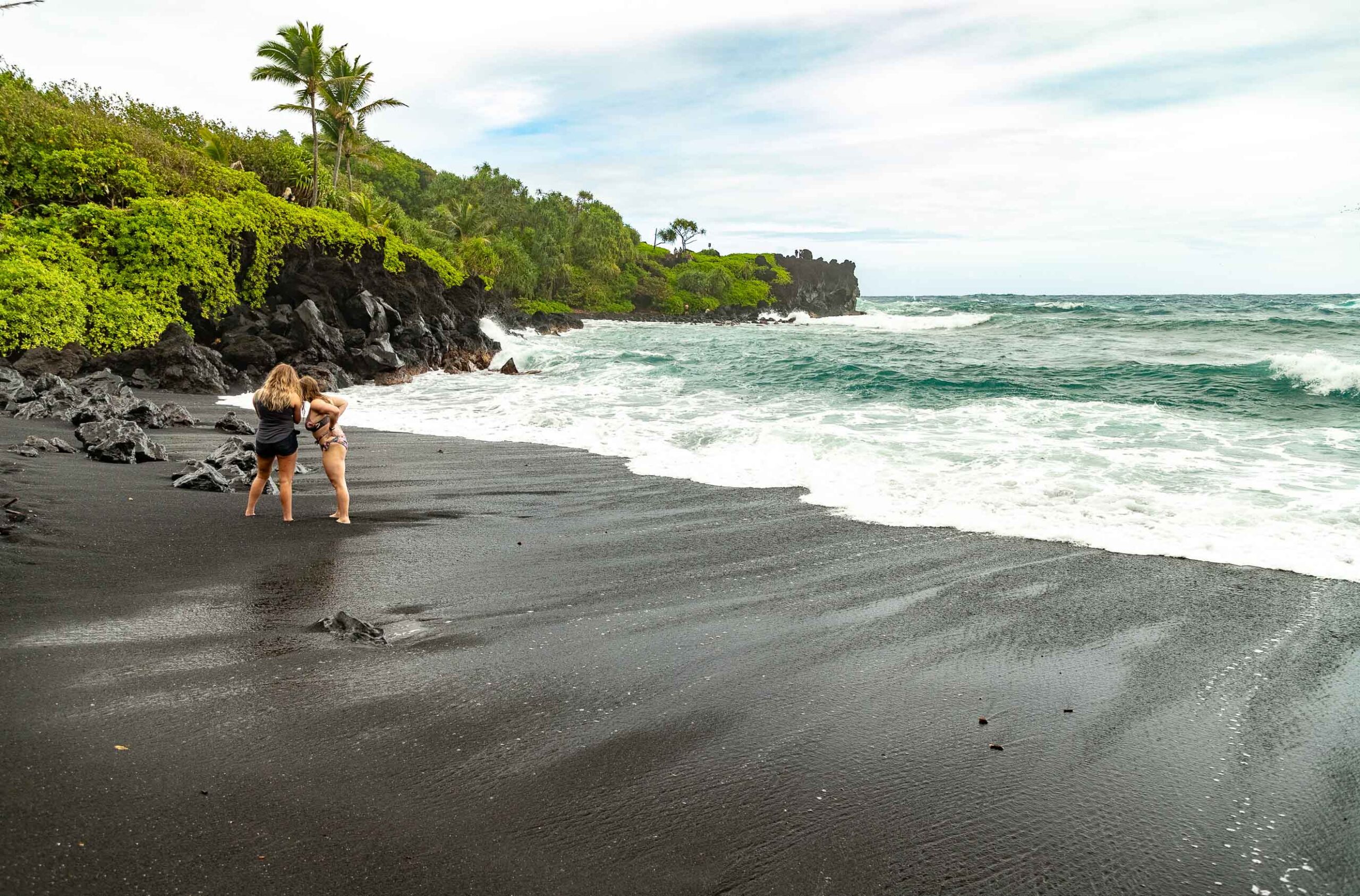
Black sand is a geological signature an immediate visual clue that powerful forces shaped the land nearby. In simple terms, black sand forms when dark, heavy minerals from volcanic rocks or ancient lava flows are eroded, transported, and concentrated by water and wind. Within the first glance, it answers a basic question of origin: where fire once dominated, black sand often follows.
Unlike the pale quartz beaches common in postcards, black sand beaches absorb light rather than reflect it. Their heat, texture, and color announce a different story of the planet. These beaches are most often found along volcanic islands, tectonic coastlines, or near mountain systems where erosion feeds mineral-rich sediments into the sea. Over time, waves remove lighter grains and leave behind the densest materials, slowly darkening the shoreline.
For geologists, black sand is evidence. It marks erosion pathways, identifies source rocks, and records the balance between land uplift and ocean energy. For travelers, it is unfamiliar and striking, challenging expectations of what a beach should look like. For communities, it can be both an asset and a concern, because black sand may contain valuable minerals while also playing a role in coastal stability. Understanding black sand means understanding how Earth reshapes itself continuously, quietly, and without regard for human timelines.
What Black Sand Is
Black sand is defined by composition rather than color alone. It is typically rich in heavy, dark minerals such as magnetite, ilmenite, augite, and hornblende. These minerals originate from basalt and other volcanic rocks that form when molten lava cools rapidly at or near the Earth’s surface.
As volcanic rocks break down through weathering, gravity and water move the fragments downslope. Rivers deliver these sediments to the coast, where waves perform a natural sorting process. Lighter materials are swept away more easily, while heavier minerals settle and accumulate. Over years or centuries, this selective process produces beaches dominated by dark grains.
A coastal geologist once described black sand as “the residue of geological endurance—the minerals heavy enough to remain when everything else is carried away.” This endurance is what gives black sand its density, warmth, and often magnetic qualities.
How Black Sand Forms
The formation of black sand is gradual and highly dependent on local geography. Volcanic activity provides the raw material, but erosion and wave dynamics determine whether black sand will appear at the surface. Without sufficient wave energy, sediments may remain mixed. Without erosion, there is no supply.
Hydraulic sorting is the key mechanism. As waves crash and retreat, they suspend sand grains momentarily. Gravity pulls heavier particles down faster, while lighter grains are pulled back into the surf. Repetition of this process concentrates dense minerals along specific stretches of coast.
Over time, storms can rearrange these deposits dramatically. A single event may expose or bury black sand layers, reminding observers that beaches are not static landscapes but constantly shifting systems shaped by energy and motion.
Where Black Sand Beaches Occur
Black sand beaches are most common near volcanic regions and tectonic plate boundaries. Island arcs, rift zones, and hotspot chains provide ideal conditions: volcanic rock, steep terrain, and active erosion.
River systems also influence their distribution. When rivers drain volcanic highlands, they transport mineral-rich sediments to coastal zones. If wave energy is sufficient, black sand accumulates along the shore. In some areas, these beaches appear only seasonally, while in others they persist for generations.
Each black sand beach reflects a localized balance between sediment supply and ocean force. This makes them valuable indicators of regional geology rather than interchangeable tourist features.
Geological Settings of Black Sand
| Setting | Source Material | Dominant Process |
|---|---|---|
| Volcanic islands | Basaltic lava | Coastal erosion |
| Mountainous coasts | Igneous rock | River transport |
| Ancient lava fields | Weathered basalt | Long-term sorting |
| Tectonic margins | Mixed heavy minerals | Wave concentration |
Black Sand Versus White Sand
The contrast between black and white sand beaches reflects fundamentally different geological histories. White sand beaches are often composed of quartz or calcium carbonate from coral and shell fragments. Their brightness comes from mineral transparency and biological origin.
Black sand, by contrast, signals volcanic or tectonic influence. It absorbs heat more readily, often becoming noticeably warmer under sunlight. This physical difference affects not only human comfort but also local ecosystems.
Comparison of Beach Types
| Feature | Black Sand | White Sand |
|---|---|---|
| Main minerals | Magnetite, basalt | Quartz, calcite |
| Typical origin | Volcanic | Biological or continental |
| Heat retention | High | Low |
| Geological signal | Tectonic activity | Stable continental crust |
Environmental Role of Black Sand Beaches
Black sand beaches play an important role in coastal environments. Their density helps stabilize shorelines by resisting erosion, and their darker color alters local temperature conditions. Some organisms have adapted specifically to these warmer, mineral-rich sands.
They also act as natural buffers against wave energy. Removing black sand through mining or construction can weaken this protective function, making coastlines more vulnerable to storm damage. Environmental scientists emphasize that black sand is not simply decorative—it is structural.
As climate change intensifies storms and raises sea levels, the stability provided by dense sand deposits becomes increasingly valuable. Preserving black sand beaches is therefore part of broader coastal resilience strategies.
Economic and Industrial Significance
Black sand often contains minerals of commercial value. Magnetite and ilmenite are used in steel production, pigments, and high-performance alloys. This has made black sand mining attractive in certain regions.
However, extraction carries environmental risks. Removing heavy minerals can disrupt sediment balance and accelerate coastal erosion. As one environmental planner noted, “Mining black sand is like removing keystones from an arch—the structure may hold briefly, but collapse becomes inevitable.”
Because of these risks, many regions regulate or prohibit black sand mining, recognizing that short-term economic gains can undermine long-term environmental stability.
Human Fascination and Cultural Meaning
Black sand has long captured human imagination. Its stark contrast with ocean water creates landscapes that feel dramatic and unfamiliar. Writers and artists often use black sand as a metaphor for transformation, loss, or renewal.
In educational contexts, black sand is frequently used to demonstrate geological principles. Simple experiments with magnets reveal its iron content, turning beaches into open-air laboratories. This accessibility makes black sand an effective teaching tool for earth science.
A science educator once observed, “Black sand makes geology visible it turns deep time into something you can feel under your feet.” That immediacy helps bridge the gap between abstract processes and lived experience.
Challenges of Conservation
Protecting black sand beaches requires recognizing their uniqueness. Standard beach nourishment practices may not apply, and heavy foot traffic or construction can alter sediment balance quickly.
Community-led conservation efforts have shown promise, particularly when education emphasizes geological value alongside tourism appeal. Legal protections in some regions limit extraction and development, acknowledging that black sand beaches are irreplaceable on human timescales.
The challenge lies in shifting perception from seeing black sand as a curiosity or resource to understanding it as a geological archive worth preserving.
Takeaways
- Black sand forms from volcanic and heavy mineral erosion.
- Its dark color reflects high density and mineral content.
- These beaches signal tectonic or volcanic activity.
- Black sand stabilizes coastlines and supports ecosystems.
- Mining poses environmental risks.
- Preservation depends on education and regulation.
Conclusion
Black sand beaches remind us that Earth’s surface is shaped by patience rather than speed. Each grain represents a long journey from molten rock to shoreline, guided by gravity, water, and time. These beaches challenge familiar ideas of beauty while offering insight into planetary processes that continue unseen beneath daily life.
As climate pressures mount and coastlines change, black sand beaches stand as both records and warnings. They tell stories of creation and erosion, resilience and vulnerability. To understand black sand is to recognize that even the smallest grains carry the weight of Earth’s history and that protecting them means respecting the forces that formed them.
FAQs
Why is black sand dark in color?
Because it contains heavy, dark minerals such as magnetite and basalt fragments.
Are black sand beaches volcanic?
Most are linked to volcanic or tectonic regions, though erosion also plays a role.
Does black sand get hotter than white sand?
Yes, it absorbs more heat due to its color and density.
Is black sand magnetic?
Often partially, because of iron-rich minerals.
Can black sand beaches disappear?
Yes, storms, erosion, and mining can remove them over time.
References
Encyclopaedia Britannica. (n.d.). Black sand. https://www.britannica.com
National Geographic Society. (n.d.). Volcanic landscapes and beaches. https://www.nationalgeographic.org
United States Geological Survey. (n.d.). Heavy mineral sands. https://www.usgs.gov
Smithsonian National Museum of Natural History. (n.d.). Volcanoes and igneous rocks. https://naturalhistory.si.edu
NASA Earth Observatory. (n.d.). Coastal geology and erosion. https://earthobservatory.nasa.gov