
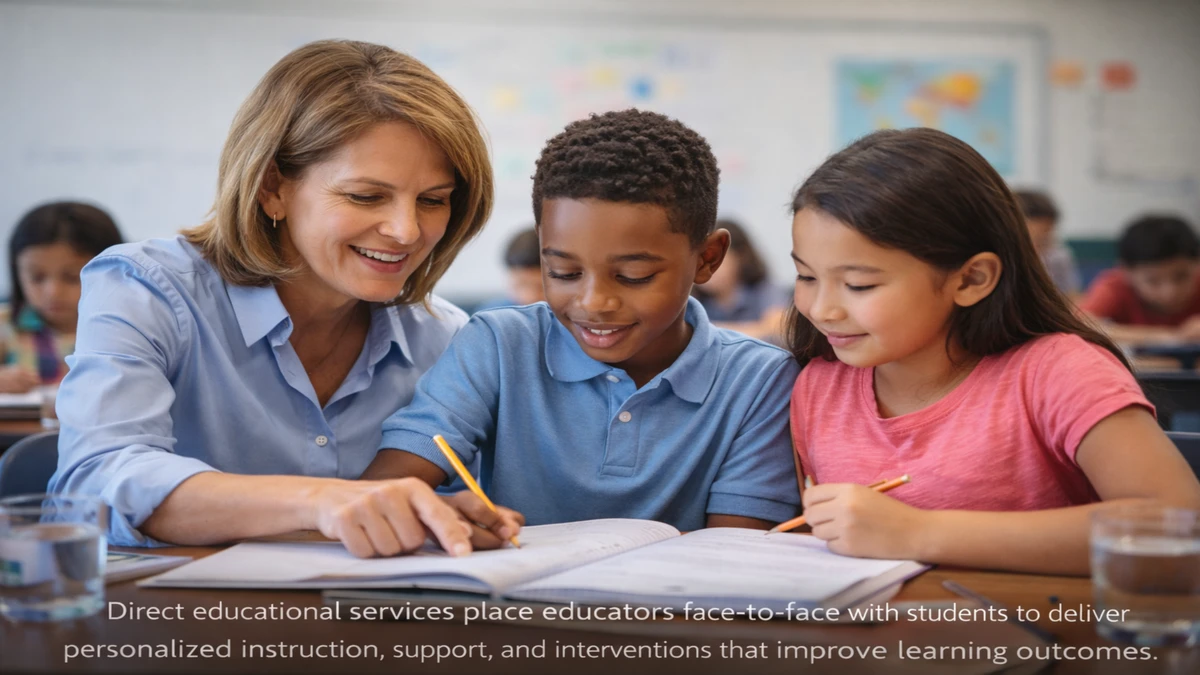
Direct educational services are the most immediate and human form of education. They are the moments when a teacher kneels beside a student to explain a concept again, when a specialist guides a child through a reading exercise, or when a counselor listens carefully to help a student regain emotional balance. These services are defined by presence, interaction, and intentionality. They occur when a qualified professional works directly with a learner to build knowledge, skills, or well-being.
For anyone searching for what “direct educational services” means, the essence is simple: they are services delivered straight to students, not around them. They contrast with indirect supports like teacher training or curriculum planning that shape learning environments but do not involve direct contact with learners. Direct services include classroom instruction, small-group interventions, individualized tutoring, speech therapy, occupational therapy, and counseling sessions.
This article explores how direct educational services function within modern education systems, why they matter, how they are structured, and what challenges they face. It looks at the legal frameworks that define them, the professional roles that deliver them, and the evidence behind their effectiveness. It also examines how direct services shape equity, inclusion, and opportunity for students across diverse learning contexts.
Defining Direct Educational Services
Direct educational services are instructional, therapeutic, or developmental activities delivered through direct interaction between professionals and students. The defining feature is that the student is the immediate recipient of the service. This interaction may be one-to-one, in a small group, or in a classroom, but it always involves purposeful engagement.
These services can include teaching academic content, supporting language development, addressing motor skills, or helping students navigate social and emotional challenges. They are documented, planned, and often measured, especially in contexts like special education where service minutes and goals are formally specified.
What distinguishes direct services from general teaching is intentionality and focus. Direct services are targeted, often addressing specific learning needs or goals. They are not simply exposure to information but guided processes designed to produce measurable change.
The Legal and Policy Context
In many education systems, direct educational services are embedded in law and policy. Special education frameworks, for example, require schools to specify what services will be delivered directly to a student, how often, and by whom. This ensures accountability and protects students’ rights to appropriate support.
Policies distinguish direct services from indirect ones to clarify responsibility and resource allocation. Without this distinction, schools could fulfill legal obligations through planning alone without ever delivering meaningful support to students. The requirement for direct services ensures that support is not abstract but tangible.
This legal framing reflects a broader societal commitment: that education is not merely access to buildings or curricula, but access to human expertise.
Direct Services in Everyday Practice
In classrooms, direct services appear as explicit instruction, guided practice, and feedback. A teacher introduces a concept, models its use, observes students trying it, and intervenes when they struggle. That loop of explanation, practice, and adjustment is a form of direct service.
In special education, direct services may involve pull-out sessions where a student works with a specialist on specific skills like decoding words or solving math problems. These sessions are tailored, intensive, and responsive.
Counselors provide direct services when they meet individually with students to discuss stress, conflict, or emotional regulation. Therapists provide direct services when they guide physical or speech development through structured activities.
Across these settings, direct services share three traits: personalization, immediacy, and adaptability.
Distinguishing Direct from Indirect Services
Indirect services support learning by shaping conditions rather than teaching directly. These include curriculum design, teacher coaching, consultation, and policy development. They are valuable, but they do not replace direct interaction.
The distinction matters because a system could invest heavily in planning while neglecting delivery. Direct services ensure that plans translate into action. They connect theory with practice and policy with lived experience.
Models and Delivery Formats
| Format | Description | Typical Use |
|---|---|---|
| Individual instruction | One-to-one teaching | Intensive skill development |
| Small group | Targeted group learning | Shared needs intervention |
| Co-teaching | Two teachers jointly instruct | Inclusive classrooms |
| Therapy or counseling | Developmental or emotional support | Well-being and access |
Another way to view direct services is by purpose.
| Purpose | Focus | Example |
|---|---|---|
| Remedial | Closing gaps | Reading intervention |
| Developmental | Supporting growth | Social skills groups |
| Enrichment | Extending learning | Advanced projects |
These formats allow schools to match support to need, maximizing impact while managing resources.
Professional Roles and Collaboration
Direct services are delivered by teachers, special educators, counselors, therapists, and sometimes trained paraprofessionals under supervision. Each brings specialized knowledge, but their effectiveness increases when they collaborate.
A reading specialist works best when aligned with classroom instruction. A counselor supports learning when communicating with teachers about student needs. Collaboration prevents fragmentation and ensures coherence.
Direct services are not isolated acts but parts of integrated educational ecosystems.
Research and Effectiveness
Educational research consistently shows that explicit, structured, and responsive teaching improves learning outcomes, especially for students who struggle. Direct interaction allows educators to notice misconceptions, provide immediate feedback, and adjust strategies in real time.
This responsiveness is difficult to replicate through indirect means alone. Technology can support learning, but it cannot fully replace the diagnostic power of human attention.
Equity and Access
Direct educational services are central to educational equity. Students from marginalized backgrounds, students with disabilities, and students facing language barriers often rely on direct support to access the curriculum.
Without direct services, these students may fall behind even when resources exist on paper. Direct services translate commitment into reality.
However, unequal funding and staffing can limit access. Ensuring equity requires not only recognizing the value of direct services but investing in them.
Challenges and Limitations
Direct services require time, skilled personnel, and coordination. Schools face shortages of specialists, high caseloads, and competing demands. Balancing individual attention with large class sizes is a persistent challenge.
There is also the risk of over-segregation when direct services pull students out of classrooms too often, potentially stigmatizing them. Inclusive models aim to integrate direct services into general settings whenever possible.
Takeaways
- Direct educational services involve face-to-face interaction between educators and students.
- They are distinct from planning or consultative supports.
- They are legally protected in many education systems.
- They are delivered through various formats and purposes.
- Collaboration enhances their impact.
- They promote equity and inclusion.
- They require sustained investment.
Conclusion
Direct educational services represent the heart of education: the relationship between teacher and learner. They embody the belief that learning is not passive absorption but active construction guided by human insight. In classrooms, counseling offices, and therapy rooms, direct services turn curriculum into understanding and support into growth.
As education systems evolve, technology and policy will continue to shape learning. Yet the core of education will remain relational. Direct services ensure that amid systems and structures, the individual student remains visible, supported, and valued.
FAQs
What are direct educational services
They are instructional or support services delivered directly to students by educators or specialists.
How do they differ from indirect services
Indirect services support teachers or environments, not students directly.
Where are direct services used
In classrooms, special education settings, counseling, and therapy.
Who provides direct services
Teachers, special educators, counselors, and therapists.
Why are direct services important
They personalize learning, support equity, and improve outcomes.