
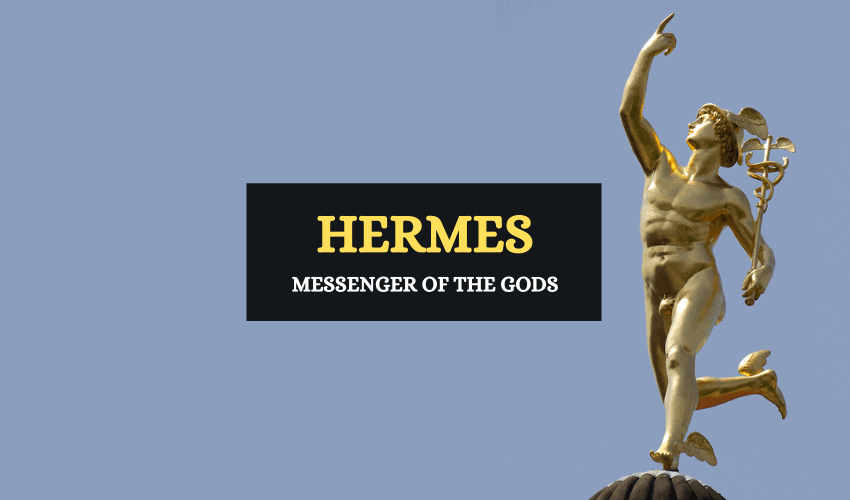
Hermes is often introduced as the Greek messenger of the gods a divine courier with winged sandals, darting between Olympus, Earth, and the Underworld. But the deeper one reads into Greek myth, the more Hermes begins to feel less like a single character and more like a living concept: movement, communication, invention, trade, and the eternal negotiation between boundaries. For thousands of years, Hermes has survived in memory not only because of his role in myth but because he represents something profoundly human the desire to connect across distances both physical and spiritual.
Within the first hundred words of his story, Hermes already appears in overlapping roles.He is the patron of travelers and the overseer of merchants. He is the trickster who defies rigidity, the inventor who brings new tools to humankind, . His myths never confine him to a single task; instead, they reveal a personality that thrives in movement.
This article explores Hermes not only as a mythological figure but as a cultural symbol whose influence stretches far beyond ancient Greece. His stories have shaped art, inspired literature, and informed modern psychology and philosophy. In an era obsessed with speed, communication, and innovation, Hermes feels strangely contemporary a deity who could easily step into today’s world of networks and motion.
Origins and Early Depictions
Hermes appears early in Greek mythology as one of the Olympian gods, born to Zeus and the nymph Maia. Ancient writers often described his birth in the quiet of a cave, his first hours marked by cleverness and restlessness. While most divine children grew into their abilities, Hermes seemed to arrive with his fully formed: intelligence, cunning, and curiosity. Artists from the Archaic and Classical periods portrayed him in varied ways. Sometimes he is young and athletic, almost boyish. Other times he is mature and bearded, a dignified traveler with a cloak and wide-brimmed hat. But the constants remain: the winged sandals, the caduceus staff, and the calm confidence of someone who controls the space between worlds.
Hermes never embodies stillness. Even in sculpture, his stance often suggests forward motion one foot slightly lifted, his cloak fluttering behind. In vase paintings, he is frequently shown guiding heroes, delivering messages, or escorting souls. Across centuries, Greek art built a visual vocabulary that aligned perfectly with his mythic role: movement as essence
Hermes as the Divine Messenger
Among the Olympians, Hermes holds the unique ability to travel freely between the realms. This freedom makes him indispensable. When Zeus needs to communicate with gods, mortals, or spirits, Hermes is sent. His tasks range from delivering warnings to conveying divine orders, from calming disputes to guiding lost travelers. But his role is not one-dimensional. Unlike messengers in modern bureaucracy bound to pass information without opinion Hermes often participates in shaping outcomes. His presence in myth suggests not only the movement of words but the interpretation of them. Hermes translates. He negotiates. He makes meaning between sender and receiver.
Many myths involve Hermes mediating conflicts or softening harsh decisions. His diplomacy lies not in force but in tact, humor, and empathy. In this sense, he represents an early understanding of communication as more than transmission; it is relationship-building, nuance, and trust. In a world that increasingly relies on intermediaries journalists, diplomats, translators, technologists Hermes feels unmistakably relevant. His mythology offers a reminder that connection is an art, not a simple exchange.
The Trickster Dimension
Hermes is not merely a polite messenger. He belongs to the global tradition of trickster gods beings who disrupt order in ways that ultimately expand human possibility. Like Loki, Anansi, and Coyote, Hermes challenges rigidity. But unlike darker tricksters, Hermes balances mischief with generosity. One of his earliest and most memorable stories involves him stealing Apollo’s cattle as a newborn. His crime is bold, but his solution is more inventive: he creates the lyre from a tortoise shell and offers it to Apollo as restitution. Instead of punishment, the gods reward him with admiration.
This myth highlights two key qualities:
Creativity emerges from disruption.
- Hermes’ mischief is constructive, not malicious.
Greek society valued ingenuity, trade, and negotiation; Hermes embodied all three. His stories invite readers to consider the messy but often fruitful boundary between rules and innovation. Today, many thinkers use the term “Hermetic” not only to refer to magic but to signify hidden meanings, clever systems, and intellectual transformation.
Hermes the Inventor and Patron of Commerce
Few gods claim as many inventions as Hermes. He is credited with creating the lyre, the panpipes, fire-sticks, weights and measures, and even aspects of the Greek alphabet. These inventions reflect a mind that sees solutions where others see obstacles. As the patron of merchants, Hermes represents the moral neutrality of trade. To the Greeks, commerce was neither inherently noble nor corrupt it was a space of opportunity, risk, and negotiation. Hermes presided over this domain not as a judge but as an overseer, guiding honest exchange and clever transactions.
Travelers invoked him at crossroads; merchants carried small Hermes figurines for protection; boundary stones dedicated to him herms stood across cities and roads. These markers were not only spiritual objects but legal and social anchors. In every sense, Hermes occupied the liminal spaces where systems meet: trade routes, city gates, borderlands, and negotiation tables. His presence suggests that human movement geographical, intellectual, economic requires a guardian.
Table: Symbols and Interpretations
| Symbol | Interpretation |
|---|---|
| Winged Sandals | Speed, mobility, the ability to shift between realms |
| Caduceus | Mediation, communication, peaceful negotiation |
| Tortoise Shell Lyre | Creativity, invention, artistic harmony |
| Traveler’s Hat | Journeying, exploration, protection |
| Herm Stones | Boundaries, law, property, civic structure |
Hermes in Literature and Art through the Ages
Hermes appears widely in ancient literature from Homer to Hesiod and his personality shifts subtly depending on the author. In The Iliad, he is respectful and strategic, guiding King Priam safely to retrieve the body of Hector. In The Odyssey, he is firm yet empathetic as he orders Calypso to release Odysseus and later provides advice to the wandering hero. Philosophical writers in the Classical and Hellenistic eras often invoked Hermes as a symbol of interpretation and learning. His association with communication made him a natural emblem for rhetoric and philosophy. Later, Roman writers transformed him into Mercury, emphasizing speed, commerce, and wit.
In medieval and Renaissance Europe, Hermes resurfaced through the Hermetica, texts attributed to a mythical sage called Hermes Trismegistus. These writings influenced alchemy, early science, and mystical philosophy, embedding Hermes deeply into Western intellectual history. Art historians trace his visual evolution from simple, athletic depictions on pottery to elaborate Renaissance paintings that portray him as a radiant messenger descending from the heavens. Across time, artists return to his dual nature: swift movement paired with contemplative intelligence.
Hermes as Guide of Souls
One of Hermes’ most intriguing roles is that of psychopomp a guide of souls to the Underworld. Unlike Hades, who rules the dead, Hermes serves as the gentle escort at the threshold. He accompanies spirits to their destination, offering the comfort of transition rather than the finality of judgment. This role expands Hermes’ identity from physical movement to metaphysical passage. He is present not only in life’s travels but in the final journey, easing the soul’s shift from one existence to another. The Greeks viewed this role with respect; it made Hermes a link between realms that others feared to cross.
His role as psychopomp may explain why later mystical traditions, including Hermetic philosophy, associated him with wisdom and transformation. To guide the dead is to understand the limits of human experience and to move gracefully beyond them.
The Enduring Modern Presence of Hermes
Even without direct worship, Hermes continues to appear in modern thought and culture. His symbolism permeates psychology, where he represents fluidity, creativity, and boundary-crossing. In literature, he appears as a prototype for characters who mediate, translate, or move between worlds. The caduceus, often confused with the staff of Asclepius, shows how deeply Hermes has entered modern iconography. Whether used correctly or mistakenly, it remains one of the most recognized symbols in the world communication entwined with harmony.
Artists, writers, and thinkers continue to draw on him because he represents something essential: the ability to navigate complexity with intelligence and grace. In an era defined by speed, networks, and constant communication, Hermes feels uniquely adapted to contemporary life. He is the god of connection in an age of connection.
Takeaways
- Hermes symbolizes movement, communication, and negotiation across boundaries.
- His trickster traits emphasize ingenuity over chaos.
- As a psychopomp, he guides transitions both physical and spiritual.
- His inventions reflect a mind oriented toward creativity and problem-solving.
- His influence spans mythology, philosophy, art, and modern symbolism.
- Hermes remains relevant as a metaphor for connection and transformation.
Conclusion
Hermes stands out among Greek gods because he is never static. He is the embodiment of transition between places, states, ideas, and worlds. His stories portray a figure who is clever without cruelty, inventive without arrogance, and powerful without domination. In the myths, Hermes influences outcomes not by force but through communication, intelligence, and adaptability.
As modern culture becomes increasingly interconnected, Hermes feels more at home than ever. His mythology speaks to the challenges of navigating complex systems, mediating differences, and embracing movement as both necessity and possibility. Whether guiding travelers, inspiring artists, or shaping symbols that endure across civilizations, Hermes remains a divine reflection of humanity’s desire to reach beyond boundaries.
FAQs
1. Why is Hermes considered the messenger of the gods?
Hermes could travel freely between Olympus, Earth, and the Underworld, making him the natural intermediary for carrying divine messages and negotiating between realms.
2. What symbols are associated with Hermes?
Common symbols include winged sandals, the caduceus staff, a traveler’s hat, and the lyre, each representing movement, mediation, or invention.
3. How is Hermes different from other trickster gods?
Hermes uses trickery creatively rather than destructively. His mischief often leads to inventions, solutions, or restored balance.
4. What role did Hermes have in the Underworld?
He served as a guide for souls, escorting them safely to the realm of the dead. He did not judge them but facilitated the transition.
5. How did Hermes influence later cultures?
Through Roman religion, Renaissance Hermeticism, and modern symbolism, Hermes shaped philosophy, art, psychology, and concepts of communication.