
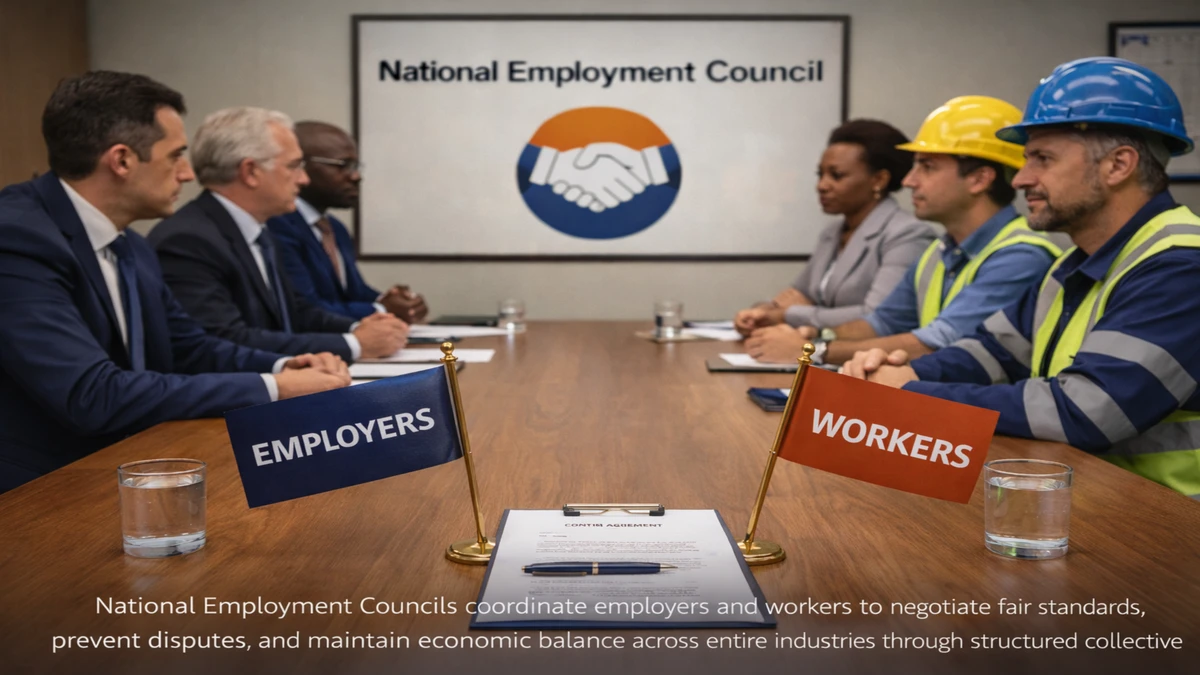
National Employment Council exist to solve one of the most persistent tensions in economic life: how to balance the needs of employers to remain competitive with the rights of workers to fair wages, safe conditions, and dignity at work. These councils operate as formal spaces where representatives of business and labour negotiate binding agreements that define how work is organized, compensated, and regulated across entire industries. Rather than leaving labour relations to conflict, courts, or unilateral decision-making, NECs embed dialogue into the structure of the economy itself.
For readers seeking clarity about what a National Employment Council actually does, the answer is practical rather than theoretical. NECs set minimum wages, define working hours, establish leave entitlements, and create systems for resolving disputes. Their agreements often carry legal force, meaning they shape everyday working life far beyond boardrooms and union halls. They influence how much people earn, how long they work, and how conflicts are resolved when things go wrong.
This article explores the logic behind National Employment Councils, how they operate, why governments rely on them, and what their presence reveals about modern labour governance. It examines their origins, mechanisms, impact, criticisms, and future in a changing world of work.
Origins and Legal Foundations of National Employment Councils
National Employment Councils emerged from the recognition that neither markets nor governments alone could adequately regulate labour relations. Markets prioritize efficiency and competition but can drive wages downward and weaken worker protections. Governments can impose standards but often lack the flexibility to adapt them to specific industries. NECs arose as a compromise between these forces.
Legally, NECs are typically grounded in labour legislation that authorizes or mandates their creation within specific sectors. That legislation defines who participates, how agreements are negotiated, how they are registered, and how they become enforceable. The result is a hybrid institution that blends negotiation with regulation.
Historically, NECs developed in contexts where industrial conflict was costly and persistent. By bringing employers and workers into structured negotiation, societies sought to replace strikes, lockouts, and litigation with dialogue and compromise. Over time, NECs became tools not only for conflict resolution but for proactive governance of work itself. – national employment council.
Roles and Functions in Collective Bargaining
At their core, NECs function as collective bargaining forums. Employer associations and employee representatives negotiate wages, benefits, working time, overtime rules, safety standards, and grievance procedures. These negotiations are not symbolic. They produce agreements that shape binding rules for thousands of workplaces.
The power of NECs lies in scale. Instead of each company negotiating separately, entire sectors agree on common baselines. This prevents a race to the bottom in labour standards and creates a level playing field for competition.
Core Functions of NECs
| Function | Purpose | Effect |
|---|---|---|
| Wage negotiation | Set minimum pay levels | Income stability |
| Conditions of work | Define hours, leave, safety | Worker protection |
| Dispute resolution | Handle grievances | Reduced conflict |
| Enforcement guidance | Clarify compliance | Legal certainty |
Through these functions, NECs turn labour relations from a series of isolated disputes into a system of ongoing governance.
How NEC Membership and Compliance Work
NECs are built on representation rather than universal membership. Employers are usually represented through industry associations, while workers are represented through trade unions or elected bodies. Individuals do not join NECs directly; they are affected by them through their sector.
Once an agreement is negotiated and registered, it typically applies across the industry, even to employers or workers who did not participate in the negotiation. This universal application prevents undercutting and ensures that negotiated standards truly become standards rather than optional guidelines.
Compliance is monitored through labour inspectorates, internal audits, and sometimes council-appointed officers. When disputes arise, the NEC’s procedures usually require mediation before escalation to courts or strikes.
NEC Models Across Industries and Nations
While the structure of NECs varies, their purpose is consistent. Some operate in construction, others in healthcare, retail, manufacturing, or agriculture. Each adapts its agreements to the economic realities of its sector.
Variation by Sector
| Sector | Typical Focus |
|---|---|
| Construction | Safety, overtime, mobility |
| Healthcare | Shift patterns, burnout prevention |
| Retail | Wages, part-time protections |
| Manufacturing | Productivity, training |
This sectoral specificity allows NECs to remain relevant and practical, rather than abstract or disconnected from daily work.
Expert Insight on NEC Efficacy
A labour economist describes NECs as “institutions that stabilize expectations, reducing uncertainty for both workers and employers.”
An industrial relations consultant notes that “the presence of a negotiation forum reduces the emotional temperature of conflict and replaces it with procedural logic.”
A social policy researcher argues that “NECs protect not only workers but ethical employers, preventing them from being undercut by those willing to exploit labour.”
These perspectives highlight NECs as tools for fairness, stability, and trust.
Collective Agreements and Legal Enforcement
Collective agreements negotiated within NECs usually become legally binding once registered with authorities. This transforms negotiated compromises into enforceable standards.
How Agreements Become Law
| Step | Action |
|---|---|
| Negotiation | Parties agree on terms |
| Registration | Agreement filed with state |
| Enforcement | Standards become mandatory |
This process gives negotiated outcomes institutional weight, ensuring they are not merely symbolic.
Dispute Resolution and Industrial Harmony
NECs embed dispute resolution into their agreements. Grievances follow defined steps: internal discussion, mediation, arbitration, and only then legal action or industrial action. This layered approach filters out minor conflicts and reserves escalation for serious issues.
By providing these channels, NECs reduce strikes, lawsuits, and workplace hostility. They convert conflict from confrontation into process.
The Role of NECs in Workforce Planning and Development
Beyond wages and disputes, NECs increasingly engage in skills development, training frameworks, and workforce planning. As technology reshapes work, councils negotiate how workers are retrained, how new roles are classified, and how transitions are managed.
This positions NECs not only as regulators of the present but as architects of the future workforce.
Challenges and Critiques of NEC Frameworks
Critics argue that NECs can be slow, bureaucratic, and dominated by large players who marginalize smaller firms or informal workers. Others say they can entrench outdated job categories and resist innovation.
Economic shocks can also strain NEC systems, as rapid change outpaces negotiation cycles. Adaptability is therefore a central challenge.
Takeaways
- NECs institutionalize dialogue between labour and capital.
- They set binding sector-wide standards.
- They prevent destructive competition on labour costs.
- They reduce conflict through structured processes.
- They support long-term workforce stability.
- They face challenges of inclusion and adaptability.
- They remain central to modern labour governance.
Conclusion
National Employment Councils represent a quiet architecture of cooperation within modern economies. They do not attract headlines like strikes or political reforms, yet they shape daily working life in profound ways. Through negotiation, registration, and enforcement, they transform competing interests into shared rules.
Their continued relevance depends on their ability to adapt to new forms of work, include marginalized voices, and respond to rapid economic change. If they succeed, NECs will remain not relics of industrial history but living institutions that balance fairness and competitiveness in a complex world of work.
FAQs
What is a National Employment Council
A formal body where employers and workers negotiate binding employment standards for a specific sector.
Are NEC agreements legally binding
Yes, once registered, they usually apply across the entire industry.
Who participates in NEC negotiations
Employer associations and worker representatives, often trade unions.
Do NECs prevent strikes
They reduce the likelihood by providing negotiation and mediation channels.
Can NECs adapt to new industries
Yes, but adaptability depends on legal frameworks and stakeholder engagement.