
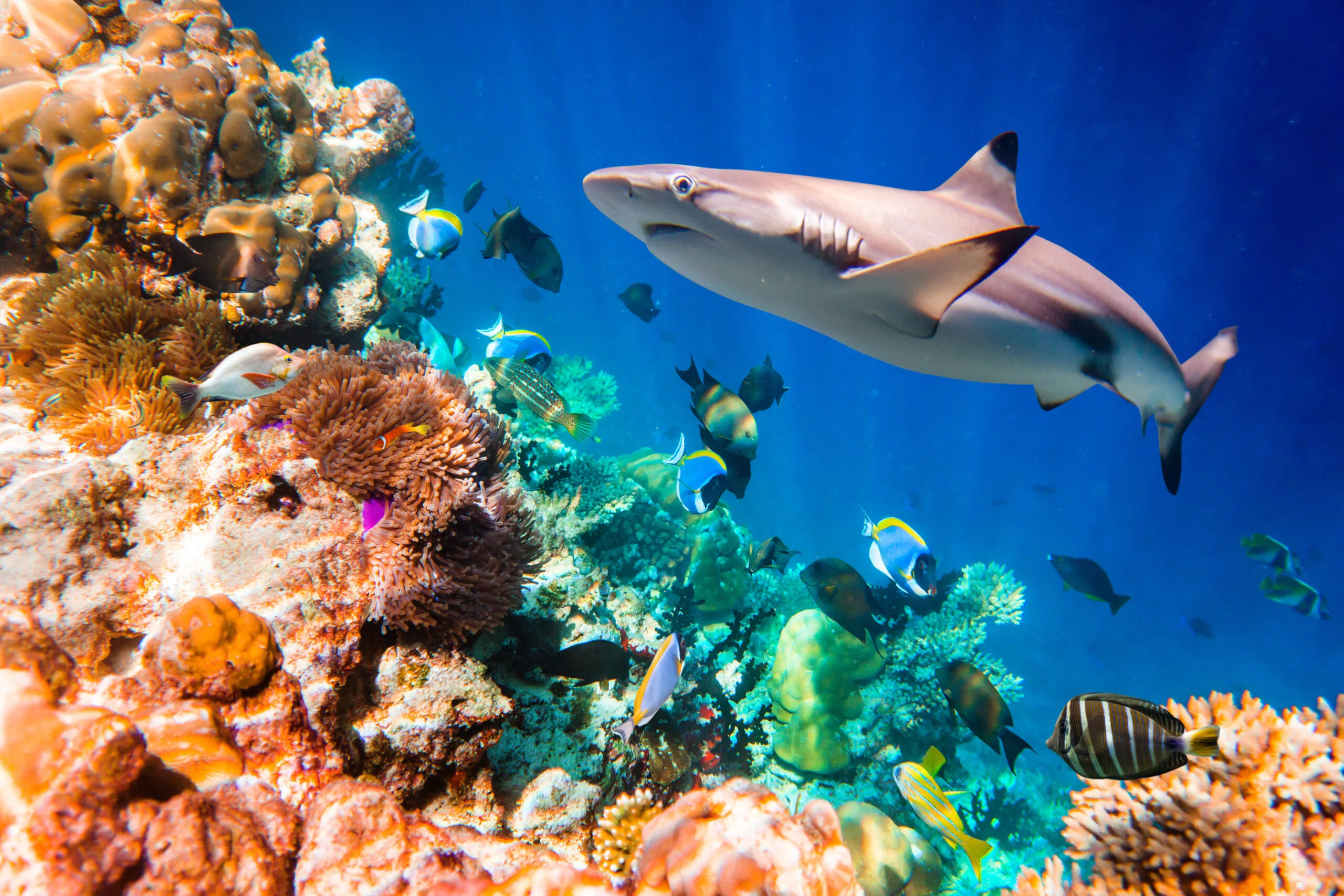
Sharks on the reef are not visitors from deeper waters; they are integral residents of coral ecosystems. Species such as gray reef sharks, blacktip reef sharks, whitetip reef sharks, and nurse sharks have evolved alongside corals and reef fish for millions of years. In the first moments of understanding this relationship, one truth emerges clearly: coral reefs function best when sharks are present.
For much of the modern era, sharks were framed as symbols of danger rather than balance. Popular narratives emphasized rare attacks while ignoring the everyday ecological work sharks perform beneath the surface. Scientific research has steadily overturned that view. Reef sharks regulate fish populations, influence feeding patterns, and help prevent ecological imbalances that can undermine coral health.
Their influence is often indirect. By simply being present, sharks alter how other species move, feed, and reproduce. This phenomenon, known as top-down control, is critical in reef systems where space and resources are tightly contested. When sharks disappear, the consequences ripple outward, reshaping entire food webs.
Today, reef sharks face unprecedented pressure from overfishing, habitat degradation, and climate-driven coral loss. Understanding sharks on the reef is no longer just a matter of curiosity or conservation ethics. It is a question tied to biodiversity, coastal economies, and the long-term survival of coral reefs themselves.
Who the Reef Sharks Are
Reef sharks differ from their open-ocean relatives in both size and behavior. Most are relatively small to medium-sized sharks that spend much of their lives within defined reef territories. Species like the whitetip reef shark are nocturnal hunters, weaving through coral crevices, while gray reef sharks patrol drop-offs and reef edges during daylight hours.
These sharks exhibit strong site fidelity, often returning to the same reefs year after year. Their streamlined bodies and advanced sensory systems are adapted to shallow, structurally complex environments. Unlike migratory pelagic sharks, reef sharks rely on healthy coral systems for shelter, prey, and breeding grounds.
Marine ecologists have long emphasized that reef sharks are not constant predators. Instead, their greatest influence lies in how they structure reef life through presence and pressure rather than sheer consumption.
The Ecological Role of Sharks on Reefs
At the top of reef food webs, sharks help regulate mid-level predators such as snappers and groupers. Without sharks, these species can become overly abundant, consuming herbivorous fish that keep algae in check. When herbivores decline, algae spread, smothering corals and reducing reef complexity.
This chain reaction, known as a trophic cascade, illustrates how the removal of a single group can destabilize an entire ecosystem. Sharks also contribute to reef health by removing weak or sick fish, indirectly supporting genetic resilience within prey populations.
As one prominent marine scientist observed, sharks act less like executioners and more like governors, setting limits that keep reef systems functional.
Scientific Understanding Over Time
| Era | Dominant View | Lasting Impact |
|---|---|---|
| Mid-20th century | Sharks seen as threats | Minimal protection |
| Late 20th century | Recognition of overfishing | Early conservation |
| Early 21st century | Trophic cascades documented | Ecosystem-based management |
| Present | Sharks as keystone species | Integrated reef protection |
Fear, Perception, and Reality
Reef sharks rarely pose danger to humans. Most species are shy, avoiding contact with divers and snorkelers. The disproportionate fear surrounding sharks has shaped public attitudes and policy far more than actual risk.
Ocean explorer Sylvia Earle has repeatedly emphasized that humans pose a far greater threat to sharks than sharks do to humans. This imbalance has consequences. Misplaced fear reduces public support for shark protection while obscuring their ecological value.
In contrast, regions that promote shark-centered ecotourism demonstrate how coexistence benefits both people and reefs. Living sharks generate sustainable economic value while reinforcing conservation incentives.
Sharks and Climate-Stressed Reefs
Climate change compounds the challenges facing reef sharks. Coral bleaching reduces habitat quality and alters prey availability. As reefs degrade, sharks may be forced to expand territories or abandon traditional sites.
Yet healthy shark populations may also enhance reef recovery. By maintaining balanced fish communities, sharks indirectly support coral regrowth following bleaching events. Their presence strengthens ecological resilience at a time when reefs are increasingly vulnerable.
A coral reef ecologist summarized this relationship succinctly: protecting sharks does not stop warming seas, but losing sharks weakens reefs’ ability to recover.
Global Patterns of Presence and Absence
| Region | Reef Shark Status | Primary Factors |
|---|---|---|
| Remote Pacific atolls | Abundant | Limited fishing |
| Caribbean reefs | Severely reduced | Historical overfishing |
| Indian Ocean | Variable | Mixed management |
| Australia’s Great Barrier Reef | Moderately stable | Zoning and enforcement |
These contrasts highlight a central lesson: where protection exists, sharks persist.
Cultural Dimensions of Reef Sharks
In many Indigenous and island cultures, reef sharks are regarded with respect rather than fear. In parts of the Pacific, sharks are seen as guardians or ancestral spirits, beliefs that historically limited exploitation.
Modern conservation increasingly recognizes the value of such cultural frameworks. Traditional ecological knowledge often aligns with scientific findings, reinforcing protection through shared values rather than regulation alone.
Protection, Sanctuaries, and the Path Forward
Shark sanctuaries and fishing restrictions have emerged as key conservation tools. These measures are most effective when paired with reef protection, enforcement, and community involvement.
Because sharks grow slowly and reproduce at low rates, recovery takes time. Still, evidence shows that when pressures are reduced, reef shark populations can rebound, restoring ecological balance.
A fisheries scientist involved in sanctuary planning noted that patience, rather than intensity, is the defining requirement of shark conservation.
Takeaways
- Reef sharks are essential to coral ecosystem balance.
- Their influence is primarily behavioral and ecological.
- Shark loss triggers harmful trophic cascades.
- Human fear of sharks is largely unfounded.
- Protecting sharks strengthens reef resilience.
- Cultural respect often supports conservation goals.
Conclusion
Sharks on the reef represent one of nature’s quiet truths: the most important forces are not always the most visible. Their absence, rather than their presence, reveals their value. As reefs face accelerating pressures from climate change and human activity, sharks emerge not as expendable predators but as allies in resilience.
Recognizing their role requires a shift in perception, from fear to understanding, from spectacle to science. Protecting reef sharks is not merely about saving a species; it is about preserving the integrity of coral reefs themselves. In choosing coexistence over exploitation, humanity holds a rare opportunity to stabilize ecosystems that have sustained coastal life for generations.
FAQs
Do all sharks live on reefs?
No. Only certain species are reef-associated; many sharks live in open oceans or deep waters.
Are reef sharks aggressive?
Most reef sharks are cautious and avoid humans.
Why are sharks important to coral health?
They regulate food webs, preventing algae from overwhelming corals.
Can reefs survive without sharks?
Reefs may persist temporarily, but long-term stability declines without sharks.
Do shark sanctuaries work?
Yes, especially when combined with enforcement and habitat protection.
References
Encyclopaedia Britannica. (n.d.). Reef shark. https://www.britannica.com
National Oceanic and Atmospheric Administration. (n.d.). Sharks. https://www.noaa.gov
Smithsonian Ocean. (n.d.). Sharks and rays. https://ocean.si.edu
International Union for Conservation of Nature. (n.d.). Shark conservation. https://www.iucn.org
Pew Charitable Trusts. (n.d.). The ecological value of sharks. https://www.pewtrusts.org