

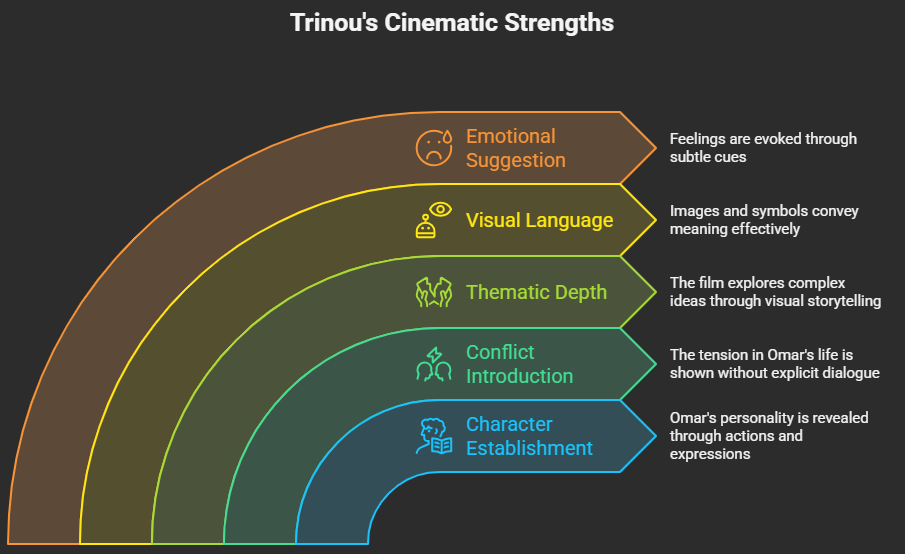
Trinou is a short dramatic film that operates with unusual restraint and emotional precision, using a child’s interior world to explore themes of limitation, imagination, and survival. Directed by Tunisian filmmaker Nejib Kthiri, the film follows Omar, a physically limited boy living in a tense domestic environment, whose inner life becomes a refuge shaped by images, fantasy, and movement. Within its compact runtime, Trinou achieves what many feature films struggle to do: it establishes character, conflict, and thematic depth without exposition or sentimentality, relying instead on visual language and emotional suggestion.
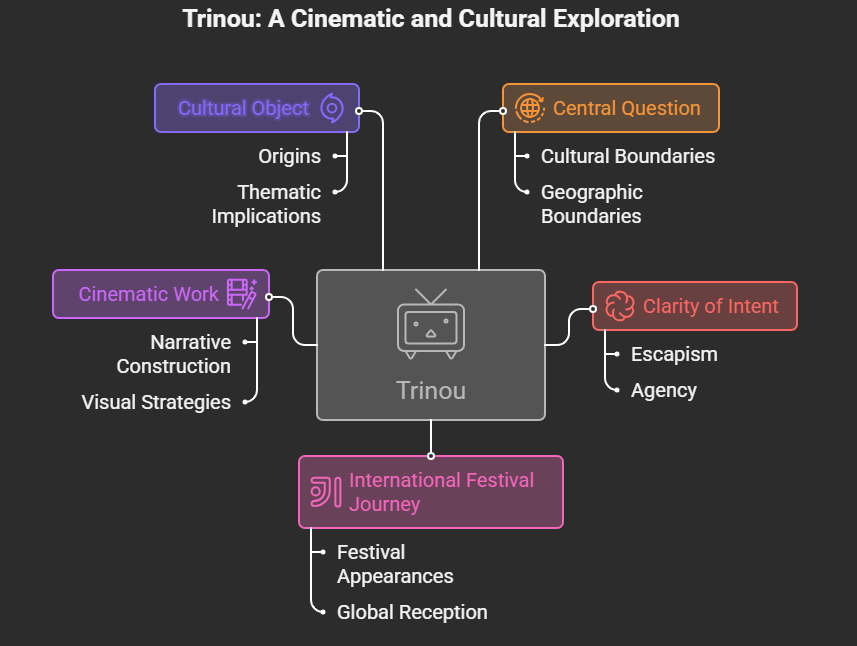
For viewers encountering Trinou for the first time, the central question is not simply what happens in the film, but why it resonates so strongly across cultural and geographic boundaries. The answer lies in its clarity of intent. Omar’s dreams are not presented as escapism alone, but as a form of authorship over his own life, a way of asserting agency when physical mobility and family dynamics limit his control. The film’s international festival journey confirms that this idea travels easily, touching audiences who recognize the universal need to imagine beyond one’s circumstances.
This article examines Trinou as a cinematic work and a cultural object. It explores the film’s origins, narrative construction, visual strategies, critical reception, and thematic implications, situating it within contemporary short-form cinema while remaining attentive to its specific emotional textures and creative decisions.
The Origins of Trinou
Trinou was written and directed by Nejib Kthiri, a filmmaker whose work often navigates the space between social realism and interior psychological experience. The film was produced by Seventh Age Pictures Limited in collaboration with Tunisian producers, reflecting a cross-regional production context that mirrors the film’s international reception. While modest in scale, the production reflects a deliberate focus on performance, visual composition, and editing rather than spectacle.
Kthiri conceived Trinou as a story told largely through images rather than dialogue. Omar’s world is defined less by what he says than by what he sees and imagines. This approach places significant responsibility on casting and direction. The choice of Max Pemberton as Omar anchors the film emotionally, while Mohamed Grayaa’s portrayal of the stepfather introduces tension without overt villainy. The performances are understated, allowing silence, gesture, and pacing to carry meaning.
The film’s editing, handled with precision, reinforces its psychological structure. Transitions between reality and imagination are fluid rather than abrupt, suggesting that for Omar, fantasy is not a separate realm but an extension of lived experience. These choices situate Trinou firmly within a tradition of art-house short films that privilege mood and interiority over narrative explanation.

Narrative Structure and Storytelling Logic
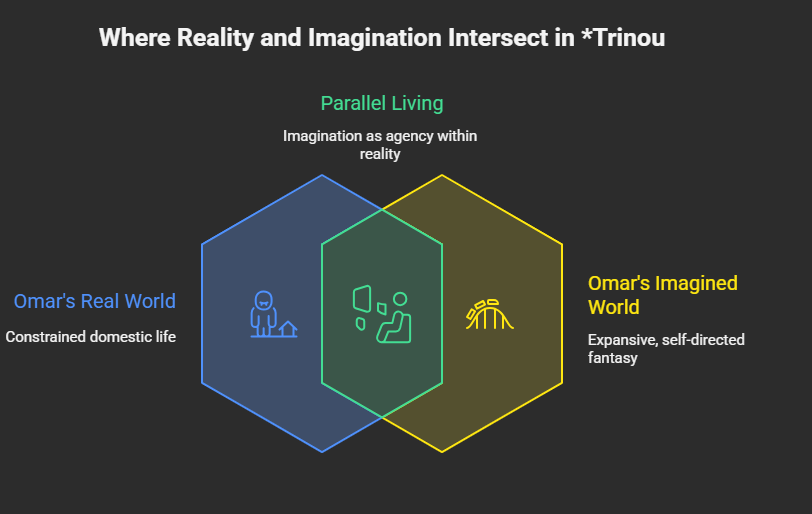
At a structural level, Trinou operates on two interwoven planes: the external reality of Omar’s home life and the internal landscape of his imagination. The film does not announce these shifts explicitly. Instead, it allows the viewer to recognize them through changes in rhythm, color, and movement. This subtlety demands attention and rewards careful viewing.
Omar’s real world is constrained by physical limitation and emotional friction. His stepfather’s presence introduces authority and impatience, while his mother occupies an uneasy middle ground, offering care without the power to transform circumstances. The domestic space is tight, visually and emotionally, reinforcing the sense of confinement that shapes Omar’s daily existence.
In contrast, the imagined sequences are expansive. Built from magazine cutouts and visual fragments, these scenes suggest motion, travel, and self-direction. The recurring image of trains becomes especially significant, symbolizing movement without requiring physical exertion. In these moments, the film articulates its central idea: imagination functions not as denial of reality but as a parallel mode of living within it.
Visual Language and Symbolic Design
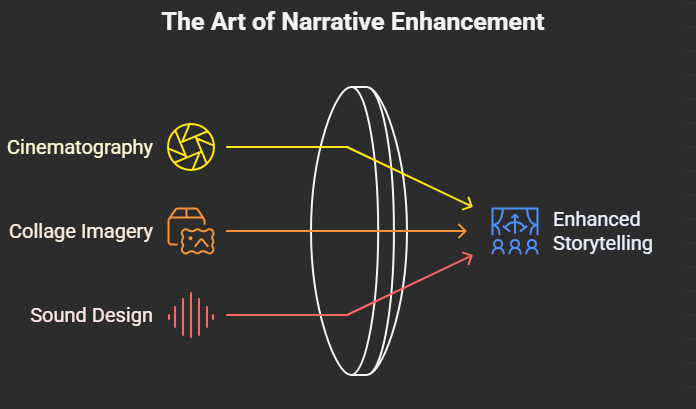
The visual design of Trinou is integral to its storytelling. Cinematography emphasizes contrast, using restrained palettes and controlled framing in the real-world scenes, then loosening both in moments of imagination. Light, texture, and camera movement shift subtly, signaling emotional transitions without relying on overt stylistic markers.
The use of collage imagery in the dream sequences is particularly effective. Rather than creating fantastical worlds through digital effects, the film grounds fantasy in physical materials: paper, images, clippings. This choice reinforces the idea that imagination is constructed from what is available, not from limitless resources. Omar’s creativity emerges from scarcity, not abundance.
Sound design further supports this visual strategy. Ambient noise dominates the domestic scenes, while imagined sequences often soften or abstract sound, creating a sense of psychological distance. Music, when present, is used sparingly, ensuring that emotional cues never overwhelm the viewer’s interpretive space.
Key Narrative and Visual Elements
| Element | Description | Narrative Function |
|---|---|---|
| Domestic Space | Confined home environment | Establishes emotional and physical limitation |
| Dream Sequences | Collage-based imagined journeys | Represents agency and inner freedom |
| Train Motif | Repeated symbol of movement | Suggests progress and escape |
| Minimal Dialogue | Sparse spoken language | Shifts focus to visual storytelling |
This careful alignment of form and meaning is central to Trinou’s effectiveness.
Festival Circulation and Global Reception
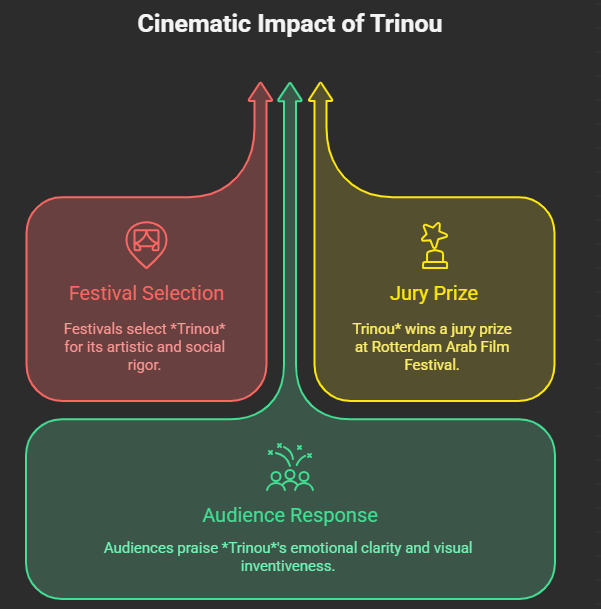
Following its completion, Trinou entered the international film festival circuit, where it was screened across Europe, North America, the Middle East, and Africa. Its selection by festivals known for curating socially and artistically rigorous short films positioned it within a global conversation about contemporary short-form cinema.
The film received particular recognition at the Rotterdam Arab Film Festival, where it was awarded a jury prize for short film. Additional screenings at events such as LA Shorts International Film Festival and regional independent film showcases expanded its reach beyond niche audiences. This circulation underscores the film’s accessibility despite its quiet tone and understated narrative.
Audience responses consistently highlighted the film’s emotional clarity and visual inventiveness. Rather than eliciting dramatic reactions, Trinou tends to leave viewers reflective, prompting conversations about childhood, disability, imagination, and family dynamics. Its success on the festival circuit suggests that restraint, when paired with intention, remains a powerful cinematic strategy.
Selected Festival Appearances
| Festival | Region | Outcome |
|---|---|---|
| Rotterdam Arab Film Festival | Europe | Jury recognition |
| LA Shorts International Film Festival | North America | Official selection |
| New York Indie Shorts Awards | North America | Competitive screening |
| Amman International Film Festival | Middle East | Audience engagement |
Critical Interpretation and Expert Commentary
Critical responses to Trinou have emphasized its economy of storytelling and emotional precision. Reviewers frequently note that the film trusts its audience, allowing meaning to emerge through observation rather than instruction. This trust aligns with broader trends in contemporary short cinema, where ambiguity and suggestion are valued over resolution.
One critic described the film as an exploration of “inner struggle rendered through visual poetry,” pointing to the way dream sequences externalize psychological states without explanatory dialogue. Another noted that Trinou resists melodrama, portraying family conflict as complex and unresolved rather than neatly framed.
Film scholars discussing short-form narratives often cite works like Trinou as examples of how compressed runtimes can intensify emotional impact. By eliminating subplots and secondary explanations, the film concentrates attention on a single experiential arc, inviting viewers to inhabit Omar’s perspective rather than observe it from a distance.
Thematic Analysis: Imagination as Agency
At its thematic core, Trinou is a film about agency. Omar’s imagination is not a passive retreat but an active process of meaning-making. Through fantasy, he reorganizes the world on his own terms, selecting images, movements, and narratives that counterbalance his physical constraints.
This framing challenges conventional portrayals of childhood disability, which often emphasize either tragedy or inspiration. Trinou avoids both extremes. Omar is neither a symbol nor a lesson; he is a character whose inner life carries as much weight as his external limitations. The film suggests that imagination is not compensation for loss but a parallel capacity that exists regardless of circumstance.
Family dynamics further complicate this theme. The stepfather’s authority and the mother’s ambivalence create an emotional environment where imagination becomes necessary rather than optional. In this sense, Trinou positions creativity as a survival skill, cultivated not in comfort but in response to pressure.
Cultural Context and Broader Significance
Although rooted in a specific social and cultural environment, Trinou resists being read as a strictly regional story. Its themes of confinement, aspiration, and interior freedom resonate across contexts, allowing international audiences to project their own experiences onto the narrative.
The film’s success illustrates how short films can function as cultural bridges, translating intimate stories into shared emotional experiences. By focusing on sensory detail rather than cultural exposition, Trinou avoids didacticism while remaining culturally grounded.
Within contemporary cinema, the film contributes to an ongoing reevaluation of the short format as a serious artistic medium rather than a stepping stone to feature production. Trinou stands on its own, complete and resolved within its chosen scale.
Takeaways
• Trinou demonstrates how short films can achieve emotional depth through restraint and visual clarity
• The film presents imagination as an active form of agency rather than escapism
• Its narrative structure balances realism with psychological interiority
• Festival recognition reflects its cross-cultural accessibility
• Performances and editing prioritize subtlety over exposition
• The film challenges simplified portrayals of childhood and disability
• Trinou reinforces the artistic legitimacy of the short-film format
Conclusion
Trinou is a film that lingers not because of dramatic spectacle, but because of its quiet confidence in the power of images and inner life. Through Omar’s perspective, it invites viewers to reconsider how freedom, movement, and authorship can exist even within severe limitations. Its international reception confirms that stories grounded in specificity can achieve universal resonance when told with care and precision.
As a work of contemporary cinema, Trinou exemplifies what the short format does best: distilling complex emotional truths into concentrated experiences that respect the intelligence and sensitivity of the audience. Long after its brief runtime ends, the film continues to move, not forward in narrative terms, but inward, prompting reflection on the ways imagination shapes how we endure, adapt, and hope.
FAQs
What is Trinou about?
Trinou follows a young boy who uses imagination to navigate physical limitation and family tension, blending realism with dreamlike visual sequences.
Who directed Trinou?
The film was written and directed by Tunisian filmmaker Nejib Kthiri.
Why is Trinou considered significant?
Its restrained storytelling, visual symbolism, and international festival recognition mark it as a notable example of contemporary short-form cinema.
What themes does the film explore?
Key themes include imagination, agency, family dynamics, and the relationship between limitation and creativity.
Where has Trinou been shown?
The film has screened at international festivals across Europe, North America, and the Middle East.
References
- Internet Movie Database. (2022). Trinou (2022). IMDb. https://www.imdb.com/title/tt13291944/ imdb.com
- Indie Shorts Mag Team. (2023, July 31). Short film review: Trinou: A quest for life’s vibrancy. IndieShortsMag.com. https://www.indieshortsmag.com/reviews/2023/07/trinou-a-quest-for-lifes-vibrancy/ indieshortsmag.com
- Knight, J. (2023, June 1). Trinou review. UK Film Review. https://www.ukfilmreview.co.uk/reviews/trinou UK Film Review
- MAD Distribution. (2022, September 14). Tunisian short film TRINOU joins Show Me Shorts Film Festival in New Zealand. MAD Distribution. https://mad-distribution.film/press/319296599816.php mad-distribution.film
- Arabisk Filmdager. (2024). Trinou. https://www.arabiskefilmdager.no/en/film/2024/trinou arabiskefilmdager.no