
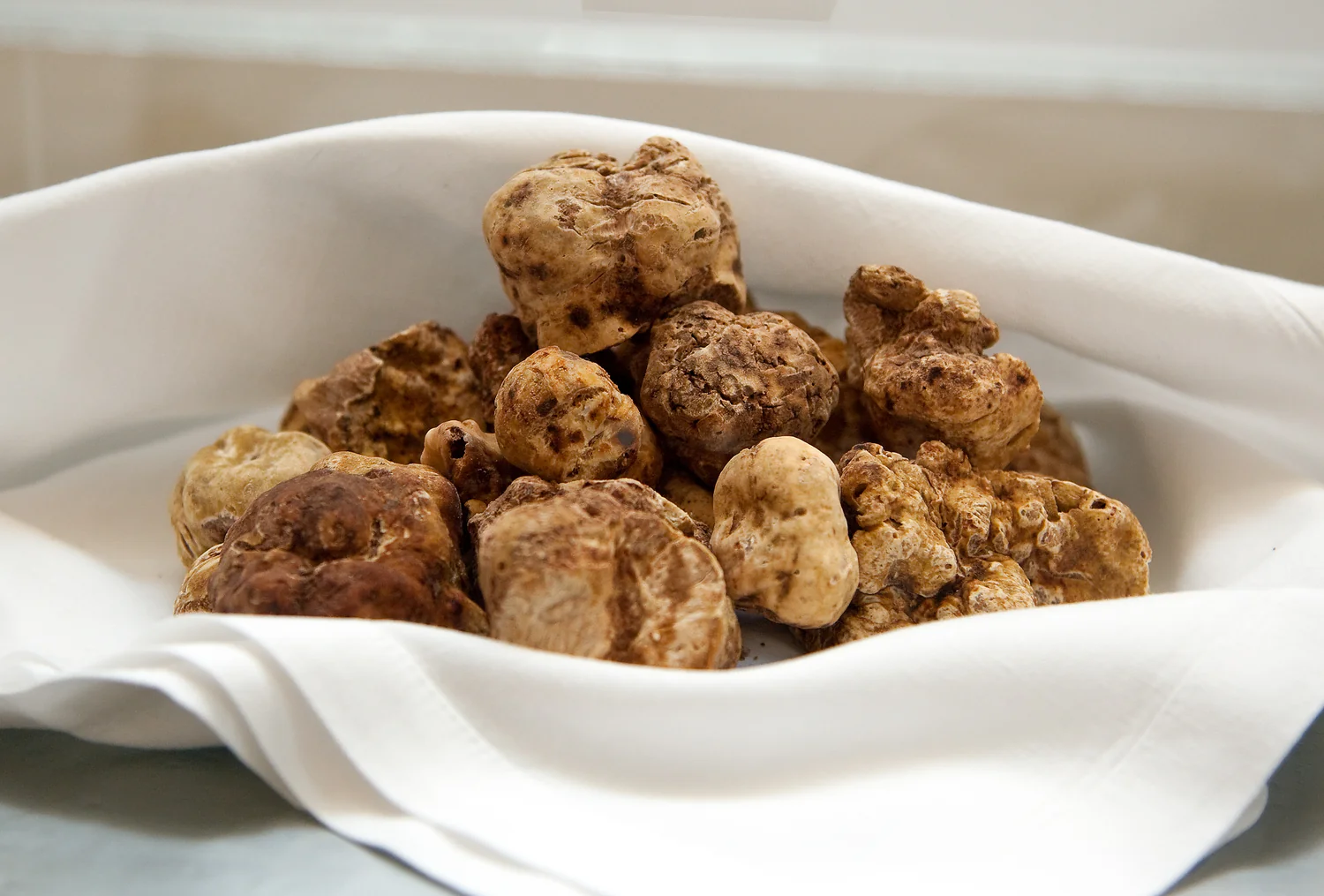
The white truffle occupies a rare position in global food culture: it is simultaneously ancient and modern, humble and extravagant, natural and mythologized. For readers seeking to understand why white truffles command extraordinary prices and enduring fascination, the answer lies not in marketing or trend cycles, but in biology, geography, and time.
At its core, the white truffle is valuable because it resists control. It grows underground, cannot be reliably cultivated, and appears only under narrow environmental conditions for a few weeks each year. Its aroma intense, volatile, and fleeting cannot be preserved, stored, or faithfully replicated. These limitations shape everything that follows: culinary practice, economic behavior, and cultural meaning.
Beyond the dining room, white truffles influence rural livelihoods, land stewardship, and scientific research. Entire regional economies in northern Italy revolve around their harvest. Seasonal markets rise and fall with rainfall patterns. Climate shifts now threaten yields that were once considered dependable.
What emerges is a story larger than food. The white truffle represents a confrontation between human desire and ecological constraint. It reminds modern consumers accustomed to abundance that some things remain governed by soil chemistry, microbial life, and chance. This article examines the white truffle not simply as a delicacy, but as a biological organism, an economic force, and a symbol of how scarcity continues to define value in an industrial world.
Biological Identity of the White Truffle
White truffles belong to the species Tuber magnatum, a subterranean fungus that lives in symbiosis with specific tree roots. Unlike surface-growing mushrooms, white truffles never break through the soil. Their spores depend on animals and human harvesters for dispersal. They form ectomycorrhizal relationships with trees such as oak, hazelnut, poplar, and willow. In this exchange, the fungus receives carbohydrates while improving the host tree’s access to minerals and water. This biological partnership explains why white truffles cannot be grown independently and why their habitats are so limited.
Physically, white truffles are irregular in shape, pale to yellowish in color, and soft compared to black truffle varieties. Internally, their marbled flesh releases aroma only when cut. Chemically, this aroma consists of dozens of volatile compounds that evaporate quickly, making freshness essential. The truffle’s biology establishes a central theme: fragility. Every culinary, economic, and cultural characteristic flows from this natural constraint.
Historical Perceptions and Cultural Meaning
Human fascination with truffles predates modern gastronomy. Ancient Greek writers speculated that truffles emerged from lightning strikes, while Roman authors praised their sensory power and medicinal value. Without visible roots or seeds, truffles appeared mysterious, even supernatural. During the Middle Ages, attitudes shifted. Some religious authorities viewed truffles with suspicion, associating their intoxicating aroma with excess. Others embraced them for perceived therapeutic benefits. By the Renaissance, white truffles were firmly embedded in aristocratic cuisine, particularly in northern Italy.
The nineteenth century marked a turning point. Improved transportation allowed fresh truffles to reach urban markets, transforming local foraging into regional commerce. Annual truffle fairs institutionalized trade, creating price systems and reputations that persist today. White truffles thus evolved from mythic curiosity to regulated commodity, without losing their aura of mystery.
Geography and Environmental Specificity
White truffles grow naturally in a narrow ecological corridor. Northern Italy remains the primary producer, with significant concentrations in Piedmont, Lombardy, and Emilia-Romagna. Smaller populations exist in parts of Croatia, Slovenia, and Serbia. Soil alkalinity, microbial diversity, tree species, and seasonal rainfall must align precisely. Even minor environmental disruptions can eliminate production. Unlike agricultural crops, truffle yields cannot be forced or predicted with precision.
Primary White Truffle Regions
| Region | Countries | Distinguishing Features |
|---|---|---|
| Piedmont | Italy | Most prized aroma, historic markets |
| Istria | Croatia | Slightly milder scent profile |
| Po Valley | Italy | Climate-sensitive production |
| Balkan Foothills | Slovenia, Serbia | Emerging but inconsistent yields |
Climate variability has begun altering traditional growing zones. Warmer summers and irregular rainfall increasingly disrupt harvests, forcing hunters to adjust routes and expectations.
Harvesting Traditions and Knowledge Systems
White truffles are harvested by trained dogs guided by experienced hunters known as trifolau. This practice requires deep ecological knowledge, passed down through generations. Dogs are preferred over pigs, which historically consumed the truffles they found. Harvesting occurs at night or early morning to preserve secrecy and soil moisture. Careless digging can damage fungal networks, reducing future yields. Responsible hunters refill holes to protect the underground ecosystem.
This informal stewardship system built on tradition rather than technology has long sustained truffle populations. As demand increases, maintaining these practices becomes more difficult but more essential.
Market Economics and Price Volatility
White truffles operate within a highly volatile market. Prices fluctuate daily based on size, aroma intensity, and seasonal yield. In poor harvest years, prices can reach several thousand euros per kilogram. Unlike manufactured luxury goods, scarcity is not engineered. It is ecological. Economists often describe white truffles as a classic example of a Veblen good, where higher prices amplify desirability. Yet producers cannot increase supply in response to demand.
Factors Influencing White Truffle Prices
| Factor | Impact on Price |
|---|---|
| Seasonal rainfall | Direct yield correlation |
| Size and aroma | Premium valuation |
| Global demand | Increases volatility |
| Climate variability | Long-term upward pressure |
Auctioned truffles often sold for charity reinforce public fascination and symbolic value, even though they represent a small fraction of total trade.
Culinary Philosophy: Minimalism and Respect
White truffles are never cooked directly. Heat destroys their volatile aroma compounds. Instead, they are shaved thinly over warm dishes that gently release scent without altering chemistry. Traditional pairings include eggs, butter, risotto, and fresh pasta. These neutral bases act as carriers rather than competitors. Strong spices or sauces are avoided.
This restraint reflects a broader culinary ethic. White truffles are not about indulgence through excess, but attentiveness to moment and season. Their role is brief and precise. As one prominent Italian chef has observed, white truffles are experienced, not consumed.
Science and the Challenge of Replication
Modern science has identified many of the chemical compounds responsible for white truffle aroma, particularly sulfur-based molecules. However, isolating these compounds fails to recreate the full sensory experience. This explains widespread criticism of synthetic truffle products, which often rely on a single dominant compound. Such products mimic intensity but lack complexity.
Genetic mapping of Tuber magnatum revealed a surprisingly intricate genome and extreme environmental sensitivity. Unlike black truffles, which have seen partial cultivation success, white truffles remain stubbornly wild. Scientific research reinforces what tradition long understood: the white truffle resists domestication.
Sustainability and Future Challenges
Growing global demand raises serious sustainability concerns. Overharvesting, habitat loss, and climate stress threaten long-term viability. Illegal harvesting and premature digging further damage fungal networks. Regulatory frameworks exist in some regions, including seasonal restrictions and licensing, but enforcement varies. Conservation efforts increasingly emphasize habitat preservation rather than cultivation. Ethically, the future of white truffles depends on restraint. Treating them as finite ecological products—rather than endlessly reproducible luxuries may determine whether they endure.
Key Takeaways
- White truffles are ecologically fragile and geographically limited
- Their value stems from natural scarcity, not artificial control
- Aroma, not flavor intensity, defines their appeal
- Markets fluctuate with climate and yield unpredictability
- Culinary tradition emphasizes restraint and seasonality
- Sustainability will determine long-term survival
Conclusion
The white truffle remains compelling because it defies modern expectations. It cannot be scaled, preserved, or standardized. Its arrival is temporary, its presence uncertain, and its disappearance inevitable. In this way, white truffles challenge the logic of industrial abundance. They force chefs, consumers, and markets to adapt to nature rather than dominate it. Their future depends not on innovation alone, but on humility on recognizing ecological limits and honoring tradition. Whether the white truffle continues as a symbol of refined pleasure or becomes a casualty of excess will reflect broader choices about how value is defined in a changing world.
Frequently Asked Questions
Why are white truffles more expensive than black truffles?
They are rarer, more fragile, and cannot be reliably cultivated.
Can white truffles be farmed?
Not consistently. Cultivation attempts remain experimental.
Why are they eaten raw?
Heat destroys the volatile aroma compounds.
How long do white truffles last?
Only a few days at peak quality, even with careful storage.
Are truffle oils authentic?
Most use synthetic compounds and do not replicate real truffles.
References
Hall, I. R., Brown, G. T., & Zambonelli, A. (2007). Taming the truffle: The history, lore, and science of the ultimate mushroom. Timber Press.
Zambonelli, A., Iotti, M., & Murat, C. (2016). True truffle cultivation: Past, present, and future. Mycorrhiza, 26(8), 711–724.
Büntgen, U., et al. (2012). Truffle cultivation in Europe under climate change. Nature Climate Change, 2(12), 827–829.
Pliny the Elder. (1855). The Natural History (J. Bostock & H. T. Riley, Trans.). Henry G. Bohn.
Montanari, M. (2013). Italian cuisine: A cultural history. Columbia University Press.