
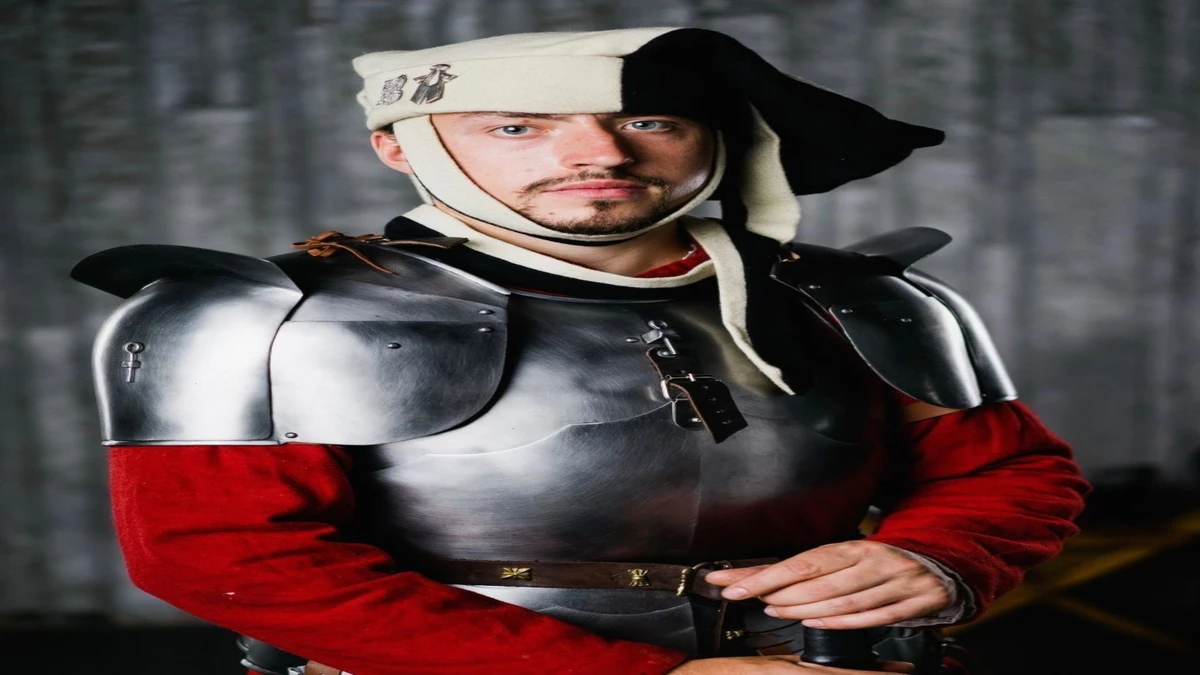
If you are searching for “pauldron,” the intent is usually clear: you want to know what a pauldron is, how it was used, and why it looks the way it does. In the simplest terms, a pauldron is a piece of plate armor designed to protect the shoulder. Yet that definition barely captures its historical importance. The pauldron was not merely defensive hardware; it was a solution to one of medieval warfare’s most difficult problems how to protect a highly mobile joint without restricting the arm’s ability to strike, ride, and maneuver in close combat. Within the first hundred words, the essential truth is this: the pauldron emerged as a sophisticated response to changing weapons, evolving tactics, and the growing personalization of armor during the late Middle Ages.
As plate armor developed in Europe between the 14th and 16th centuries, shoulders became increasingly vulnerable. Swords, polearms, and lances targeted joints, not solid plates. Armorers responded by engineering layered, articulated defenses that could move with the body. The pauldron became one of the most visually distinctive results of that innovation. Its flared plates, overlapping lames, and asymmetrical designs were functional, but they also conveyed rank, regional style, and even political identity.
This article examines the pauldron in depth: its origins, mechanical design, regional variations, and symbolic meaning. Drawing on historical sources, museum collections, and modern scholarship, it explains how this single component of armor reflects broader shifts in medieval technology, warfare, and culture. The pauldron’s story is not just about armor; it is about how societies adapt craftsmanship to the demands of violence and power.
What Is a Pauldron?
A pauldron is a plate armor component worn over the shoulder, typically extending to protect the upper arm, shoulder joint, and sometimes the collarbone and upper chest. It developed from earlier forms of shoulder protection such as spaulders and mail-based defenses. By the 15th century, the pauldron had become a defining feature of full plate harnesses worn by knights and men-at-arms.
Unlike rigid breastplates or helmets, pauldrons had to accommodate motion. The shoulder is one of the body’s most complex joints, capable of rotation, extension, and elevation. A fixed plate would severely limit combat effectiveness. To solve this, armorers used articulated lames—overlapping metal strips—connected by rivets or sliding mechanisms. This allowed the pauldron to flex while maintaining coverage.
In many harnesses, pauldrons were asymmetrical. The left pauldron was often larger to protect against incoming blows during combat, particularly in jousting or shieldless fighting. This asymmetry underscores how pauldrons were shaped by practical battlefield considerations rather than purely aesthetic ones.
Origins and Early Development
The pauldron did not appear suddenly. Its origins lie in the gradual evolution of European armor during the 13th and 14th centuries. Early medieval warriors relied heavily on mail, which offered flexibility but limited protection against concentrated force. As weapons grew heavier and more specialized, armorers began reinforcing vulnerable areas with plates.
By the late 14th century, shoulder defenses evolved from simple spaulders—small shoulder plates—into more complex structures. These early pauldrons were modest, often consisting of a single plate combined with mail voiders beneath. Over time, as plate armor became more comprehensive, pauldrons expanded in size and complexity.
The widespread adoption of full plate armor in the 15th century coincided with improvements in metallurgy and forging techniques. Steel could be worked thinner without sacrificing strength, enabling more elaborate articulation. The pauldron became a showcase of an armorer’s skill, balancing strength, flexibility, and weight distribution.
Design and Mechanical Function
From a mechanical standpoint, the pauldron is one of the most sophisticated components of medieval armor. It typically consisted of a main shoulder plate, several lames covering the upper arm, and a collar or attachment point connecting it to the breastplate or gorget. The articulation allowed the wearer to raise and lower the arm while maintaining coverage.
Straps, buckles, and arming points secured the pauldron to the body. Some designs allowed quick removal, which was useful for travel or repair. Others were permanently integrated into the harness. Weight distribution was critical; a poorly balanced pauldron could cause fatigue or impede movement.
Modern reconstructions show that a well-made pauldron could offer remarkable mobility. This challenges the popular misconception that medieval armor was clumsy or immobilizing. In reality, armor was engineered for dynamic combat, and the pauldron exemplifies that principle.
Regional Variations in Pauldron Design
| Region | Distinctive Features | Typical Period |
|---|---|---|
| Italian | Rounded forms, elegant lines, balanced symmetry | 15th century |
| German | Angular shapes, fluted surfaces, pronounced asymmetry | Late 15th–early 16th century |
| English | Functional designs, moderate articulation | 14th–15th century |
| Burgundian | Decorative edging, emphasis on rank | 15th century |
Italian armorers favored smooth, globular forms that emphasized fluid movement. German armor, particularly Gothic styles, featured sharp angles and fluting that increased rigidity while reducing weight. These regional differences reflected both aesthetic preferences and local combat traditions.
Pauldrons in Warfare and Combat
On the battlefield, the pauldron played a crucial defensive role. Shoulder injuries were often fatal, as they could disable the sword arm or sever major blood vessels. By protecting the shoulder joint, the pauldron helped ensure a warrior could continue fighting.
In mounted combat, pauldrons protected against downward strikes and lance impacts. In infantry engagements, they guarded against polearms and axes aimed at joints. Their asymmetrical designs often corresponded to fighting stances, offering greater protection on the side most exposed to enemy blows.
Historical accounts and surviving armor indicate that pauldrons were adapted to specific combat contexts. Tournament armor featured exaggerated pauldrons for jousting, while field armor favored lighter, more practical designs.
Symbolism and Status
Beyond function, pauldrons carried symbolic weight. Armor in the late Middle Ages was a marker of social status, and pauldrons were highly visible components. Elaborate decoration, gilding, and engraving signaled wealth and rank.
Heraldic motifs were sometimes incorporated into pauldrons, turning them into moving emblems of identity. In courtly contexts, armor was worn in ceremonies and parades, where visual impact mattered as much as protection. The pauldron thus became both shield and symbol.
Comparison: Pauldrons and Related Armor Pieces
| Armor Piece | Body Area Protected | Key Difference |
|---|---|---|
| Spaulder | Shoulder | Smaller, less articulated |
| Pauldron | Shoulder and upper arm | Larger, articulated, often asymmetrical |
| Gardbrace | Reinforced pauldron | Used in jousting for extra protection |
| Vambrace | Forearm | Protects lower arm |
This comparison highlights how the pauldron fit into a larger system of articulated armor, each piece tailored to a specific anatomical and tactical need.
Expert Perspectives on Medieval Armor
Dr. Tobias Capwell, curator of arms and armor, has noted that “the sophistication of plate armor is often underestimated; components like pauldrons reveal a deep understanding of biomechanics and combat realities.”
Historian Alan Williams emphasizes metallurgy, arguing that advances in steel production made articulated armor viable on a large scale.
Arms scholar Kelly DeVries points out that armor design must be understood alongside tactics, not in isolation.
These expert views reinforce the idea that pauldrons were not ornamental excesses but rational responses to historical conditions.
Decline and Legacy
By the late 16th century, firearms reduced the effectiveness of plate armor. As armor declined, pauldrons became smaller or disappeared altogether. Yet their legacy endured in ceremonial armor and later artistic depictions of knights.
Modern fantasy and gaming have revived the pauldron as a visual shorthand for martial power. While often exaggerated, these portrayals draw on authentic medieval forms. Museums and reenactment communities continue to study and recreate pauldrons, preserving their technical heritage.
Takeaways
- A pauldron is a shoulder armor piece designed for mobility and protection
- It evolved alongside advances in plate armor and metallurgy
- Regional styles reflect cultural and tactical differences
- Pauldrons balanced function with symbolism and status
- Their design demonstrates medieval understanding of biomechanics
- Modern depictions often exaggerate but derive from real forms
Conclusion
The pauldron stands as a testament to medieval ingenuity. Far from being a crude or purely decorative object, it represents a careful negotiation between protection, movement, and meaning. Its layered plates and articulated joints reveal an understanding of the human body that feels strikingly modern. At the same time, its visibility made it a canvas for identity, rank, and artistic expression. To study the pauldron is to glimpse how medieval societies confronted violence with craftsmanship and turned necessity into form. In that sense, the pauldron is not just armor; it is history shaped in steel.
FAQs
What is a pauldron used for?
It protects the shoulder and upper arm while allowing movement in combat.
Were pauldrons always symmetrical?
No. Many were asymmetrical to protect the more exposed side.
Did all knights wear pauldrons?
Most late medieval knights did, but designs varied by region and period.
Are pauldrons heavy?
Well-made pauldrons were balanced to minimize fatigue.
Why are pauldrons exaggerated in fantasy?
Modern media amplifies their size for visual impact, not historical accuracy.
References
- Blair, C. (1958). European armour circa 1066 to circa 1700. London: Batsford.
- Capwell, T. (2012). Armour of the English knight 1400–1450. Leeds: Royal Armouries.
- DeVries, K., & Smith, R. D. (2012). Medieval military technology. Toronto: University of Toronto Press.
- Edge, D., & Paddock, J. M. (1988). Arms and armor of the medieval knight. New York: Crescent Books.
- Williams, A. (2003). The knight and the blast furnace. Leiden: Brill.