
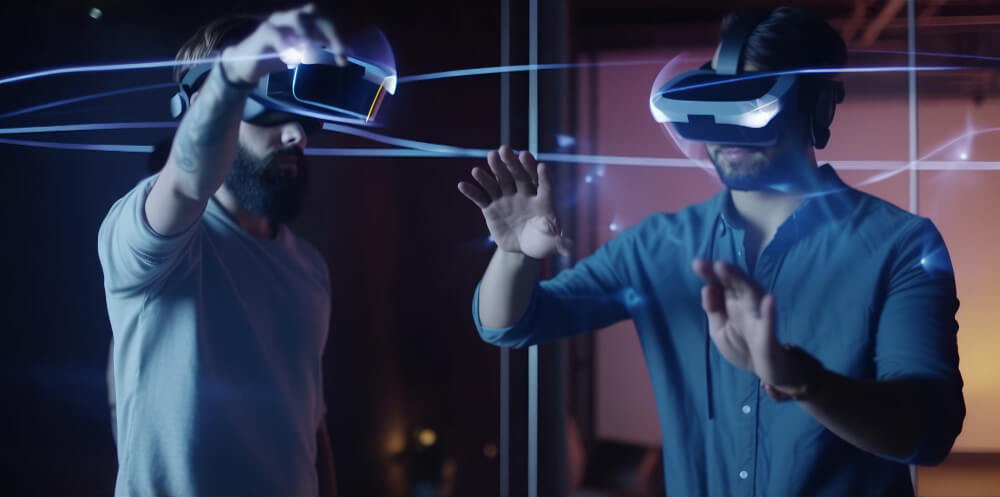
ARK augmented reality refers to a category of augmented reality systems designed to understand, map, and persist within physical environments. Rather than floating digital overlays loosely on a screen, ARK-style systems embed virtual objects into real-world space with precision. For users, the experience feels less like viewing content and more like encountering it information exists where it belongs.
At its core, ARK augmented reality answers a practical question: how can digital objects behave as if they are part of the physical world? The solution lies in spatial awareness. These systems continuously interpret surroundings, track movement, and adjust digital elements accordingly. A virtual object remains fixed to a surface, responds to lighting conditions, and obeys spatial logic.
This shift represents a turning point for augmented reality. Earlier implementations focused on novelty, producing effects that impressed briefly but failed to sustain practical use. ARK-style systems prioritize reliability and continuity. They assume that digital experiences should persist across time, location, and users.
As augmented reality matures, ARK emerges not as a single product but as an architectural philosophy one that treats the physical world as a structured dataset. The implications extend beyond entertainment into education, healthcare, architecture, and daily productivity. In this framework, augmented reality becomes less about spectacle and more about integration.
Defining ARK Augmented Reality
ARK augmented reality is defined primarily by spatial anchoring. Digital objects are not merely displayed; they are placed. This placement relies on a shared coordinate system between device and environment, allowing virtual elements to occupy consistent positions relative to physical space.
Another defining characteristic is persistence. Once placed, digital objects can remain in the same location across sessions. The system recognizes the environment again and restores content accordingly. This persistence transforms augmented reality from a momentary effect into an ongoing layer of information.
Environmental understanding also plays a central role. ARK systems detect surfaces, depth, and spatial boundaries. They know where a wall begins and ends, where a floor slopes, and where objects block visibility. These capabilities allow digital elements to behave convincingly within real environments.
Technological Foundations
The backbone of ARK augmented reality is simultaneous localization and mapping, commonly known as SLAM. Through SLAM, devices map surroundings while tracking their own position within that map. This dual process allows systems to orient digital objects accurately and maintain stability during movement.
Computer vision complements SLAM by interpreting visual input. Cameras identify features such as edges, textures, and contrast points, which collectively form a three-dimensional understanding of space. Over time, this information becomes increasingly refined.
Depth sensing enhances accuracy further. By measuring distance directly, systems reduce errors caused by poor lighting or featureless surfaces. Together, these technologies create the illusion that digital content genuinely inhabits physical space.
Hardware Enablers
ARK augmented reality depends on tightly integrated hardware components. Cameras provide continuous visual data, while inertial sensors track orientation and acceleration. In advanced systems, depth sensors or LiDAR units supply precise spatial measurements.
Mobile devices have become the most common ARK platforms due to their sensor density and accessibility. Head-mounted displays offer deeper immersion but remain limited by cost, battery life, and comfort.
The trend across hardware development emphasizes efficiency and miniaturization. As sensors shrink and processing power increases, ARK-style augmented reality becomes more seamless and less intrusive.
Software Architecture and Spatial Logic
Beyond hardware, ARK augmented reality relies on software frameworks that manage spatial logic. These frameworks handle object placement, coordinate transformations, lighting estimation, and physics simulation.
Lighting estimation ensures that digital objects match ambient conditions, reducing visual dissonance. Physics simulation allows virtual elements to respond naturally to gravity and collisions. These subtleties are essential; without them, even precisely placed objects appear artificial.
Developers often describe ARK systems as teaching software to respect reality. The closer digital behavior aligns with physical expectations, the less effort users expend interpreting what they see.
Applications Across Industries
| Sector | Application | Functional Benefit |
|---|---|---|
| Education | Spatial learning models | Improved understanding |
| Healthcare | Anatomical visualization | Greater precision |
| Architecture | Design previews | Faster iteration |
| Retail | Product visualization | Higher engagement |
These applications demonstrate that ARK augmented reality is not confined to entertainment. Its value emerges wherever spatial context matters.
Cultural and Social Implications
ARK augmented reality introduces new social questions. When digital objects occupy shared physical spaces, issues of ownership and control arise. Who decides what content appears in public locations? Who moderates persistent digital layers?
Cultural theorists suggest that ARK systems extend architecture into the digital realm. Virtual structures guide attention and movement much like physical ones. As such, augmented reality becomes a form of environmental design.
This convergence of digital and physical governance represents a new frontier, one where norms and regulations have yet to fully form.
Expert Perspectives
Human–computer interaction researchers emphasize that spatial interfaces reduce cognitive load. Information placed in physical context requires less mental translation than abstract data on flat screens.
Technology ethicists warn that persistent digital overlays can shape perception subtly. What people see repeatedly in physical space influences behavior and belief, making design choices especially consequential.
Industry analysts note that trust will determine adoption. Users must believe that spatial data is accurate, respectful, and secure for ARK augmented reality to become ubiquitous.
Key Takeaways
- ARK augmented reality focuses on spatial anchoring
- SLAM enables stable placement and persistence
- Hardware and software evolve together
- Applications extend beyond entertainment
- Social norms lag behind technical capability
- Trust and design ethics shape adoption
Conclusion
ARK augmented reality marks a quiet but profound evolution in computing. By embedding digital content into physical space with stability and persistence, it transforms how people encounter information. The technology succeeds not by drawing attention to itself, but by fading into the background supporting human activity without demanding focus.
As ARK-style systems continue to mature, their influence will become less visible but more pervasive. Digital objects will feel less like additions and more like extensions of reality itself. In that future, augmented reality is not an escape from the world, but a deeper engagement with it.
Frequently Asked Questions
What is ARK augmented reality?
It describes AR systems that anchor digital objects to physical space.
Is ARK a product or platform?
It is an architectural approach, not a single product.
How is it different from basic AR?
ARK emphasizes stability, persistence, and spatial understanding.
What devices support it?
Primarily mobile devices and emerging AR wearables.
Why does spatial anchoring matter?
It makes digital content believable and usable.
References
Azuma, R. T. (1997). A survey of augmented reality. Presence: Teleoperators and Virtual Environments, 6(4), 355–385.
Milgram, P., & Kishino, F. (1994). A taxonomy of mixed reality visual displays. IEICE Transactions on Information and Systems, E77-D(12), 1321–1329.
Sherman, W. R., & Craig, A. B. (2018). Understanding virtual reality: Interface, application, and design (2nd ed.). Morgan Kaufmann.
Sutherland, I. E. (1968). A head-mounted three dimensional display. Proceedings of the Fall Joint Computer Conference, 757–764.
Zhou, F., Duh, H. B. L., & Billinghurst, M. (2008). Trends in augmented reality tracking, interaction and display. Presence: Teleoperators and Virtual Environments, 17(2), 193–202.