
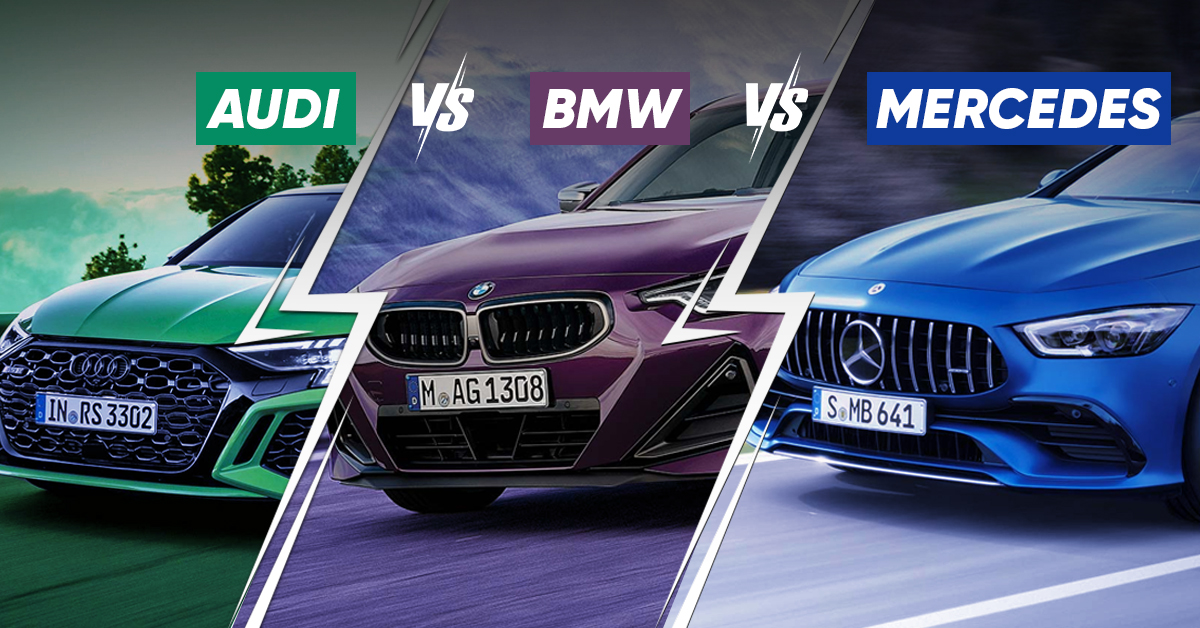
When people type “bm vs” into a search bar, they are rarely asking a neutral question. They are usually standing at a crossroads figuratively or literally trying to decide between BMW and Mercedes-Benz, two brands that have come to symbolize opposing ideas of what a luxury car should be. Within the first moments of consideration, the intent is clear: which brand offers better performance, greater prestige, deeper engineering credibility, or longer-lasting value?
Yet this rivalry is not simply a matter of horsepower or leather quality. It is a story about identity. BMW and Mercedes-Benz represent two philosophies that have shaped the modern automobile and, by extension, modern ideas of success, comfort, and ambition. One speaks in the language of driver engagement and balance. The other speaks in the language of refinement, safety, and technological authority.
For more than a century, these companies have grown side by side, sometimes borrowing from one another, often reacting to one another, always defined by comparison. Their competition has unfolded across racetracks, executive garages, advertising campaigns, and global markets. It has survived wars, economic upheaval, environmental regulation, and now the transition to electric mobility.
This article explores the BMW versus Mercedes-Benz rivalry not as a buyer’s checklist, but as a long-form examination of how two German manufacturers came to define luxury in fundamentally different ways. It traces their origins, engineering choices, design philosophies, business strategies, and cultural symbolism, revealing why this rivalry remains so powerful and why it still matters.
Historical Foundations: Two Paths Into the Automobile
Mercedes-Benz occupies a unique position in automotive history. The brand traces its origins to Karl Benz’s 1886 Patent-Motorwagen, widely regarded as the first practical automobile. From the beginning, the company’s identity was tied to invention, mechanical authority, and the very legitimacy of the automobile itself. When Benz & Cie. merged with Daimler-Motoren-Gesellschaft in 1926, the resulting company carried not just products, but historical weight.
BMW’s beginnings were markedly different. Founded in 1916 as Bayerische Motoren Werke, the company initially focused on aircraft engines. Precision, lightweight engineering, and performance under extreme conditions shaped its culture long before it built cars. When BMW entered automobile production in the late 1920s, it brought with it an engineering mindset that emphasized balance, responsiveness, and mechanical clarity.
These distinct origins mattered. Mercedes-Benz approached automobiles as systems meant to endure, protect, and impress. BMW approached them as machines meant to respond, communicate, and involve. Over time, these philosophies hardened into brand identities that customers could feel even if they could not always articulate why.
Engineering Philosophy: Two Ideas of Excellence
At the heart of the BMW versus Mercedes-Benz debate lies engineering intent. BMW has long prioritized driving dynamics, focusing on near-perfect weight distribution, responsive steering, and chassis balance. The company’s engineers often speak of the relationship between driver and machine, framing the car as an extension of human input.
Mercedes-Benz, by contrast, has historically emphasized ride comfort, safety innovation, and mechanical authority. Its vehicles are engineered to isolate occupants from the road, smoothing imperfections and minimizing fatigue. This philosophy produced many industry firsts, including early safety cell designs and advanced restraint systems.
| Engineering Priority | BMW | Mercedes-Benz |
|---|---|---|
| Core focus | Driver engagement | Comfort and safety |
| Chassis tuning | Balanced, firm | Composed, compliant |
| Steering feel | Direct, communicative | Stable, insulated |
| Brand identity | Performance-led | Innovation-led |
Automotive historians often note that BMW builds cars that reward attention, while Mercedes-Benz builds cars that reduce the need for it. Neither approach is inherently superior, but each appeals to different definitions of luxury.
Design Language and Visual Identity
Design is where this rivalry becomes immediately visible. BMW’s exterior language emphasizes motion. Long hoods, short overhangs, and aggressive detailing communicate speed and intent, even when the car is stationary. The kidney grille and Hofmeister kink have become visual signatures, evolving over decades while remaining unmistakable.
Mercedes-Benz design has traditionally leaned toward elegance and authority. Proportions are upright, surfaces are smoother, and visual drama is often restrained in favor of continuity. This approach reinforces trust and timelessness, particularly among long-term buyers.
BMW has frequently used design provocation to signal modernity, sometimes polarizing audiences in the process. Mercedes-Benz has relied on gradual evolution, ensuring that new models remain immediately recognizable. Design critics often describe this as a contrast between experimentation and reassurance.
Performance Divisions and Motorsport Influence
Motorsport has played a central role in defining how both brands approach performance. BMW’s M division, established in 1972, translated racing experience into road cars that emphasized agility and balance. Models like the M3 became legends by proving that race-bred performance could coexist with everyday usability.
Mercedes-Benz performance identity is closely tied to AMG, which emphasizes power, sound, and emotional impact. AMG vehicles often deliver dramatic acceleration and aggressive character, appealing to drivers who equate performance with force and presence.
| Performance Arm | BMW M | Mercedes-AMG |
|---|---|---|
| Character | Precise, balanced | Powerful, dramatic |
| Motorsport roots | Touring car racing | GT racing, Formula One |
| Emotional appeal | Control and feedback | Sound and speed |
Industry analysts have noted that BMW’s withdrawal from Formula One reinforced its road-car focus, while Mercedes-Benz’s dominance in modern Formula One strengthened its image as a technological powerhouse.
Interior Philosophy: Driver-Centric Versus Lounge-Like
Inside the cabin, philosophical differences continue. BMW interiors traditionally angle controls toward the driver, reinforcing the idea that the car exists to be driven. Ergonomics and logical control placement have been hallmarks of the brand, even as digital interfaces have grown more complex.
Mercedes-Benz interiors often feel more architectural. Symmetry, ambient lighting, and high-grade materials create a sense of calm and luxury that extends to all occupants, not just the driver. This approach aligns with the brand’s emphasis on comfort and shared experience.
Both brands have pushed digital innovation, but with different priorities. Mercedes-Benz tends to introduce new systems earlier, sometimes at the cost of complexity. BMW often refines interfaces before widespread adoption, emphasizing usability.
Business Strategy and Market Positioning
Strategically, BMW and Mercedes-Benz occupy similar global territory but approach it differently. BMW positions itself as a performance-oriented premium brand, targeting customers who value driving dynamics and modern design. Mercedes-Benz casts a wider net, offering everything from entry-level luxury to ultra-high-end sedans and limousines.
During the global financial crisis of 2008, BMW maintained independence and doubled down on efficiency and brand focus. Mercedes-Benz, as part of Daimler, leveraged industrial scale and diversification to weather the downturn.
Both brands expanded aggressively into SUVs during the 2010s, responding to global demand shifts. While this expansion blurred traditional distinctions, underlying engineering and branding differences remained intact.
Electrification and the Future of the Rivalry
The transition to electric mobility represents the most significant disruption in automotive history since the invention of the internal combustion engine. BMW entered the electric space early with experimental models that emphasized efficiency and lightweight construction. Mercedes-Benz responded with scale, launching a dedicated electric sub-brand focused on luxury continuity.
BMW electric vehicles often prioritize efficiency and driving balance. Mercedes-Benz electric models emphasize range, quietness, and comfort. Analysts suggest that while electrification narrows mechanical differences, brand philosophy remains a powerful differentiator.
Software, user experience, and brand trust may ultimately matter more than drivetrain layout in the electric era an arena where both brands are investing heavily.
Cultural Meaning and Social Signaling
Beyond engineering, BMW and Mercedes-Benz function as cultural symbols. BMW often signals ambition, individuality, and upward mobility. Mercedes-Benz signals arrival, authority, and institutional success. These perceptions influence purchasing decisions as strongly as technical specifications.
Sociological research on luxury consumption shows that brands operate as social language. In this sense, the BMW versus Mercedes-Benz rivalry exists not just on the road, but in how drivers see themselves and how they wish to be seen.
Takeaways
- BMW and Mercedes-Benz embody distinct philosophies of luxury
- Historical origins shaped long-term engineering priorities
- Design language reflects cultural positioning
- Performance divisions express different ideas of speed
- Interiors reveal driver versus passenger focus
- Electrification is reshaping, but not erasing, differences
Conclusion
The enduring power of the “bm vs” debate lies in its refusal to resolve. BMW and Mercedes-Benz are not chasing the same destination by different routes; they are defining different destinations altogether. One champions engagement and responsiveness. The other champions comfort and authority. As the automotive world shifts toward electrification and digitalization, the mechanical distinctions that once defined this rivalry may soften. Yet the philosophical divide remains. Brand identity, shaped over more than a century, does not disappear with a change in powertrain.
Ultimately, BMW versus Mercedes-Benz is less about choosing the better car and more about choosing the story a driver wants to inhabit. That choice deeply personal, quietly symbolic ensures that this rivalry will continue, even as the road ahead grows quieter.
FAQs
Is BMW more performance-focused than Mercedes-Benz?
Traditionally, yes. BMW emphasizes driving dynamics, while Mercedes-Benz emphasizes comfort and refinement.
Which brand has a longer history?
Mercedes-Benz traces its roots to 1886, making it older than BMW, which was founded in 1916.
Are BMW and Mercedes-Benz equally reliable?
Reliability varies by model and year. Both brands perform similarly overall, with complexity influencing outcomes.
Which brand is more luxurious?
Luxury is subjective. Mercedes-Benz emphasizes comfort and prestige; BMW emphasizes performance-oriented luxury.
Does electrification reduce the difference between them?
It narrows mechanical gaps, but brand philosophy and user experience still differ significantly.
References
Adler, D. (2016). Mercedes-Benz: The complete history. Chronicle Books.
Robson, G. (2009). The BMW century: The ultimate history of BMW. Motorbooks.
Ingrassia, P. (2011). Engines of change: A history of the American dream in fifteen cars. Simon & Schuster.
Wells, P., Nieuwenhuis, P., & Orsato, R. (2012). The nature and causes of inertia in the automotive industry. Journal of Cleaner Production, 48, 65–75. https://doi.org/10.1016/j.jclepro.2012.08.020
Draelos, Z. D. (2010). Cosmetic dermatology: Products and procedures. Wiley-Blackwell.