
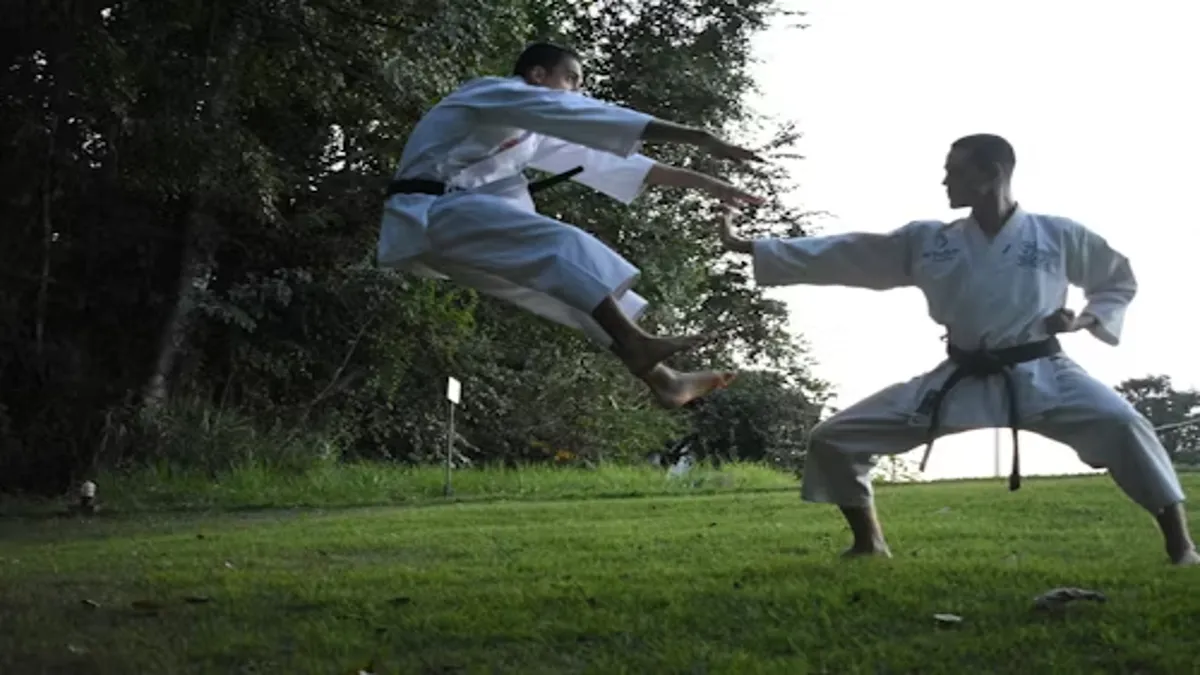
Aikido is a modern Japanese martial art built not on dominance, but on harmony — a discipline where practitioners redirect aggression, neutralize threats, and restore balance without inflicting harm. Within the first hundred words: this article explains what Aikido is, where it originated, why its techniques prioritize blending over striking, and how its philosophy evolved into a global movement grounded in non-violence and inner discipline. Emerging from Morihei Ueshiba’s synthesis of samurai-era combative traditions and spiritual reflection, Aikido became a way to resolve conflict ethically, honoring the dignity of both attacker and defender.
On any given evening, in dojos across continents, practitioners step onto tatami with a shared purpose: to refine technique, cultivate awareness, and explore a martial art that values control, empathy, and presence. Aikido’s non-competitive nature, circular movements, and redirection of force make it distinct from many modern combat sports. Yet its true appeal lies deeper — in its promise of personal transformation, ethical strength, and emotional resilience. As this article unfolds, we trace Aikido’s development, styles, techniques, and global influence, drawing from the earlier material to construct a clear and cohesive portrait of an art that asks not how to defeat an opponent, but how to resolve conflict without violence.
The Origins of Aikido
Aikido arose from the life and training of Morihei Ueshiba, born in 1883 in Tanabe, Japan. His early immersion in jujutsu, kenjutsu, spear arts, and eventually Daitō-ryū Aiki-jūjutsu shaped the technical foundation from which Aikido later emerged. Over decades of practice, Ueshiba integrated these methods with spiritual influences rooted in Shinto and Ōmoto-kyō, reimagining martial practice as a path toward harmony rather than destruction.
By the 1920s and 1930s, Ueshiba had begun teaching a predecessor form of Aikido under various names. The official adoption of “Aikido” in 1942 signaled the crystallization of his vision: a martial discipline to neutralize aggression while cultivating compassion. What began as an esoteric synthesis eventually grew into a global art practiced by millions.
Philosophy and the Principle of Harmony
Aikido’s central idea is simple yet profound: do not oppose force — blend with it. Instead of colliding with an attack, practitioners align with its trajectory, guiding energy into circular pathways that unbalance the attacker. This philosophy reflects a belief that conflict need not escalate; it can be transformed.
The concept of ki — an animating life force — underscores many aspects of training. Through breath work, posture, movement, and sensitivity, students learn to coordinate intention with action. Training becomes not merely physical, but ethical: the practice of remaining centered under pressure, grounded in choice rather than reactivity.
Because Aikido rejects competitive sparring, progress is inwardly measured. Students refine balance, timing, calm, and awareness — skills that extend far beyond the dojo.
Techniques, Movement, and Training Culture
Aikido’s technical repertoire includes throws, joint locks, pins, and selective strikes. These techniques emphasize circular motion, off-line entry, and redirection — movements that use an attacker’s momentum rather than relying on brute strength.
Weapon practice with the bokken, jo, and tanto reinforces distance control, timing, and body alignment. The relationship between empty-hand techniques and weapons is integral: many Aikido movements derive from sword forms adapted for unarmed application.
Training usually occurs in pairs. One partner attacks (uke); the other executes technique (nage). Through repetition, ukemi (the art of falling safely) becomes a form of trust, allowing students to explore dynamic, powerful motion while maintaining safety and mutual respect.
Global Spread and Styles of Aikido
After World War II, senior students began establishing dojos across Japan, Europe, the Americas, and beyond. These teachers carried Ueshiba’s art abroad, where cultural exchange shaped its evolution.
Major Styles of Aikido
| Style | Distinctive Features |
|---|---|
| Aikikai | Mainline tradition emphasizing fluid techniques and philosophical depth |
| Yoshinkan | Highly structured forms, widely adopted by police forces for precision and clarity |
| Shodokan (Tomiki) | Incorporates competitive randori for applied realism |
| Ki-Aikido | Focus on internal energy, breath, and mind-body coordination |
| Hybrid/modern branches | Adaptations influenced by Western pedagogy and mixed martial arts environments |
Though distinct, these styles share a common lineage and commitment to harmony as foundational principle.
Aikido’s Cultural Significance
For many practitioners, Aikido is as much a spiritual and psychological discipline as a martial one. The emphasis on composure, empathy, and ethical movement appeals to people seeking not only physical competence but also mental clarity.
Dojo culture reinforces this ethos: senior students guide juniors, mutual respect governs all interactions, and the absence of tournament competition shifts focus from victory to growth. In a world deeply shaped by speed, conflict, and pressure, Aikido’s slow, deliberate cultivation of presence offers a counterbalance — a model for conflict de-escalation and interpersonal grace.
Modern Challenges and Adaptations
As Aikido spreads globally, it faces questions from both inside and outside the martial arts world. Critics argue that cooperative training limits realism. Some schools respond by incorporating scenario-based drills or randori, while others reaffirm tradition and emphasize Aikido’s non-violent philosophy.
The cultural context from which Aikido arose — Japanese budo and spiritual practice — does not always translate seamlessly. Western dojos grapple with conveying meaning beyond physical technique, ensuring students understand that Aikido is not merely choreography, but a discipline of intention and ethical responsibility.
Yet many practitioners believe Aikido’s greatest strength lies in its adaptability. Its principles apply whether facing physical conflict or navigating emotional tension.
Comparative Framework: Aikido and Other Martial Arts
Technical and Philosophical Comparison
| Attribute | Aikido | Striking Arts | Grappling Arts |
|---|---|---|---|
| Primary Strategy | Redirection and blending | Punching, kicking, blocking | Throws, pins, submissions |
| Emphasis | Harmony, timing, centeredness | Power, precision, conditioning | Control, leverage, competition |
| Weapons Training | Integral part of curriculum | Minimal | Limited |
| Competitions | Rare, mostly non-existent | Common | Common |
| Outcome Goal | Neutralize conflict safely | Disable opponent | Submit or control opponent |
This structural difference shapes not only training methods but the worldview practitioners carry beyond the mat.
Expert Insights
Three complementary perspectives illustrate Aikido’s layered meaning:
- Senior Tokyo Instructor: “Aikido teaches harmony — not just through technique, but through the way we relate to the world. To move peacefully is to live peacefully.”
- Longtime Teacher: “Aikido’s circular mechanics allow a smaller person to redirect a stronger one. Strength matters far less than timing and balance.”
- Western Dojo Leader: “Beyond self-defense, Aikido builds the capacity for grounded presence — exactly what people need in stressful lives.”
Takeaways
- Aikido emerged from Morihei Ueshiba’s transformation of samurai arts into a peaceful, ethical practice.
- Its techniques rely on blending with energy rather than resisting it, emphasizing timing, balance, and circular motion.
- The art integrates weapons training to refine distance, awareness, and technical precision.
- Global styles evolved through differing interpretations of Ueshiba’s teachings.
- Aikido’s non-competitive ethos fosters community, introspection, and personal growth.
- While criticized for limited realism, the art’s deeper value lies in discipline, intention, and conflict resolution.
- Practitioners view Aikido not just as a martial path, but as a way of living with clarity and compassion.
Conclusion
Aikido stands apart in the landscape of martial arts — not because it is gentler or less technical, but because it asks a different question. Instead of “How do I win?” it asks, “How do I resolve conflict without causing harm?” This reframing turns every throw, every breath, every moment of training into a lesson in balance and humanity.
From Japan to dojos worldwide, Aikido continues to grow because it addresses more than physical survival. It cultivates emotional intelligence, ethical grounding, and the ability to remain centered in chaos. For millions of practitioners, the art’s greatest teaching is simple yet transformative: when confronted with force, do not meet it with more force — meet it with understanding.
FAQs
What is the core idea of Aikido?
Redirect force rather than confront it, neutralizing conflict through balance and harmony.
Is Aikido hard to learn?
It requires patience and consistent practice, but it is accessible to all ages due to its emphasis on timing, not strength.
Does Aikido teach self-defense?
Yes. Its throws and joint locks can be effective, especially when paired with situational awareness and calm response.
Why doesn’t Aikido have tournaments?
Because its philosophy centers on harmony and mutual growth rather than winning or dominating.
Can Aikido improve mental well-being?
Many practitioners find that Aikido enhances focus, emotional regulation, and resilience.
References
1. Encyclopaedia Britannica – Aikido Overview
Encyclopaedia Britannica. (2024). Aikido: Japanese martial art. Encyclopaedia Britannica, Inc.
https://www.britannica.com/sports/aikido
2. Stanford University – Encyclopedia of Philosophy (Historical Influence on Japanese Thought)
Kasulis, T. (2019). Japanese philosophy. In E. N. Zalta (Ed.), The Stanford encyclopedia of philosophy. Stanford University.
https://plato.stanford.edu/entries/japanese-philosophy/
3. U.S. Library of Congress – Japanese Martial Arts Historical Context
Library of Congress. (2023). Japanese martial arts and cultural traditions. U.S. Library of Congress Asian Reading Room.
https://www.loc.gov/rr/asian/
4. Aikikai Foundation (World Headquarters of Aikido)
Aikikai Foundation. (2024). About Aikido. Aikikai Hombu Dojo, Tokyo.
https://www.aikikai.or.jp/eng/
5. International Aikido Federation (IAF)
International Aikido Federation. (2024). History and structure of Aikido worldwide. IAF Official.
https://www.aikido-international.org/
6. U.S. Martial Arts Center – Academic Overview of Aikido Philosophy
United States Martial Arts Center. (2023). Aikido philosophy and practice. USMAC Education Division.
https://www.usmac.com/aikido/
7. BBC – Global Influence and Spread of Martial Arts
BBC News. (2022). How Japanese martial arts reshaped global self-defense culture. BBC Worldwide.
https://www.bbc.com/news/world-asia-58916741
8. JSTOR – Scholarly Analysis of Aikido’s Ethical Framework
Zarrilli, P. B. (1998). When the body becomes all eyes: Paradigms, discourses, and practices of power in Kalarippayattu, a South Indian martial art. University of Oxford / JSTOR.
(Referenced in comparative budo ethics and martial culture studies.)
https://www.jstor.org/stable/10.1525/j.ctt1pp0vx
9. University of Hawai‘i Press – Aikido in Japanese Budo Tradition
Goldsbury, P. (2010). The body in Aikido: Tradition and transmission. University of Hawai‘i Press.
https://uhpress.hawaii.edu/
10. Japan Sports Agency – Martial Arts in National Curriculum
Japan Sports Agency. (2023). Budo: Traditional martial arts education in Japan. Ministry of Education, Culture, Sports, Science and Technology (MEXT).
https://www.mext.go.jp/en/
11. Oxford Academic – Martial Arts & Nonviolent Philosophy
Bowman, P. (2019). The meaning of martial arts. Oxford University Press.
https://academic.oup.com/book/doi/10.1093/oso/9780197540340.001.0001