
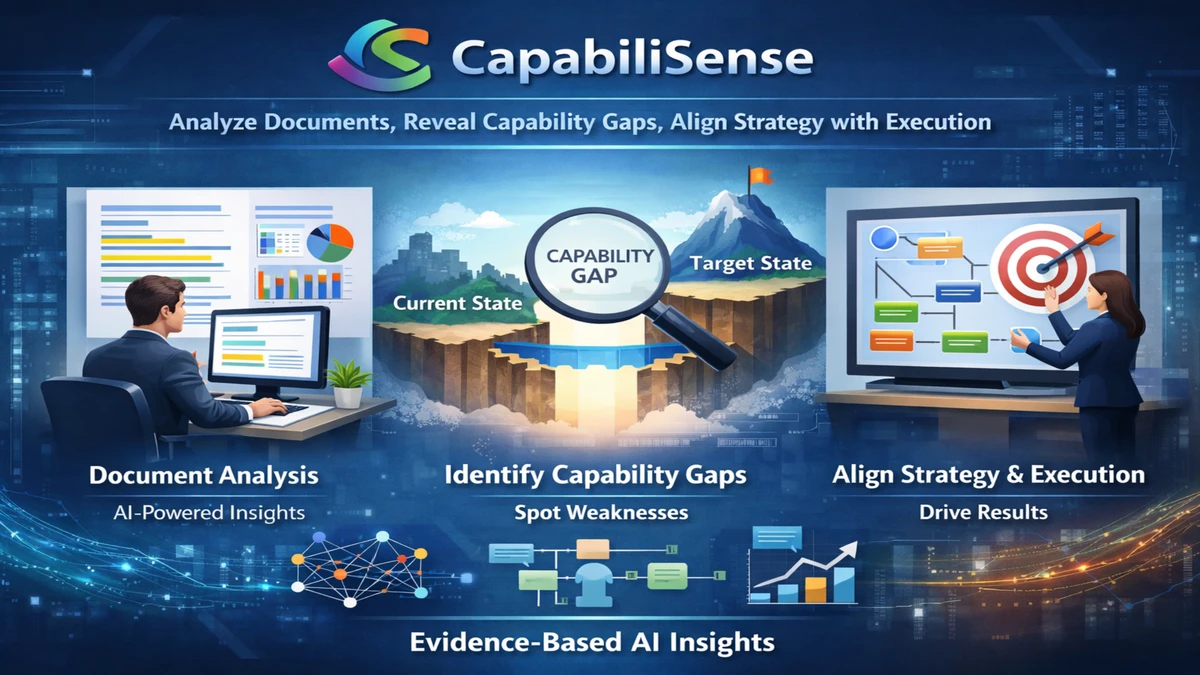
CapabiliSense Platform is an AI-driven capability intelligence platform designed to help organizations understand where they truly stand and what they must do next. It answers a question that executives, transformation leaders, and consultants face repeatedly: how to bridge the gap between ambitious strategy and messy operational reality. By reading and analyzing existing organizational documents, CapabiliSense produces a structured, evidence-based view of capabilities, gaps, risks, and priorities. Instead of relying on interviews, workshops, or opinion-driven assessments, it turns what already exists inside the organization into a coherent strategic map.
Modern organizations are saturated with plans, roadmaps, architectures, policies, and presentations. Each of these documents reflects a fragment of truth, shaped by the perspective of a specific team or leader. Over time, these fragments drift apart, contradict one another, or become outdated without anyone noticing. CapabiliSense treats this documentary sprawl not as noise but as a rich signal. Its AI engine ingests the text, detects patterns and inconsistencies, and reconstructs an integrated picture of how strategy is expressed, interpreted, and operationalized across the organization.
The result is not simply another dashboard or report, but a form of organizational self-awareness. CapabiliSense does not tell leaders what they should want; it shows them what they have already said, planned, and committed to, and how well those commitments align. In doing so, it transforms transformation itself into a more grounded, less emotional, and more collaborative process.
The Idea Behind Capability Intelligence
Capability intelligence is the notion that an organization’s ability to act can be observed, measured, and reasoned about through its own artifacts. Strategies, process descriptions, architectures, and policies encode assumptions about what the organization can do and how it intends to do it. Traditionally, this knowledge is extracted through interviews and workshops, which are slow, subjective, and politically sensitive.
CapabiliSense formalizes this extraction process through AI. It treats organizational documentation as a living representation of collective intent and institutional memory. By analyzing this material systematically, the platform identifies declared capabilities, missing capabilities, conflicting assumptions, and unsupported ambitions. This creates a shared factual basis for conversations that are otherwise driven by opinion, hierarchy, or narrative power.
This shift is subtle but profound. Instead of asking people to describe reality, CapabiliSense observes how reality is already described. It moves the organization from a mode of self-reporting to one of self-reflection, where the system becomes a mirror rather than a judge.
How CapabiliSense Works
At a technical level, CapabiliSense ingests large volumes of unstructured text and applies natural language processing to extract meaning, intent, and structure. It recognizes references to goals, capabilities, processes, technologies, roles, risks, and dependencies. It then maps these elements into an internal capability model, where relationships and gaps become visible.
The platform is framework-agnostic. Users can align the analysis with any transformation model, whether focused on cloud adoption, digital maturity, operating model change, or organizational agility. CapabiliSense does not impose a single worldview but adapts to the conceptual language already in use.
The system also detects contradictions and drift. If one document assumes centralized governance while another assumes autonomy, CapabiliSense flags this tension. If a strategy references capabilities that are not supported by any operational plan, that gap becomes explicit. In this way, the platform reveals not only what exists, but what is missing, misaligned, or implicitly assumed.
Typical Use Cases
CapabiliSense is most valuable in situations where complexity, scale, and ambiguity collide. Large transformation programs, mergers, digital initiatives, and cloud migrations all generate massive amounts of documentation and stakeholder perspectives.
In a cloud transformation, for example, one team may focus on infrastructure readiness, another on application migration, and a third on security and compliance. Each produces its own plans and narratives. CapabiliSense integrates these into a single capability view, showing how well they align, where they overlap, and where critical gaps remain.
Consulting firms use CapabiliSense to accelerate discovery and diagnosis. Instead of spending weeks interviewing stakeholders and synthesizing notes, they can ingest client documentation and begin with a structured, evidence-based understanding. This allows consultants to focus their human effort on interpretation, facilitation, and decision-making rather than on mechanical synthesis.
Executives use CapabiliSense as a sense-making tool. It allows them to see beyond presentations and status reports into the deeper structure of organizational intent and readiness, supporting more grounded strategic decisions.
Comparison with Traditional Approaches
| Dimension | Traditional Assessments | CapabiliSense |
|---|---|---|
| Data source | Interviews and surveys | Existing documentation |
| Speed | Slow | Fast |
| Subjectivity | High | Lower |
| Scalability | Limited | High |
| Consistency | Variable | Systematic |
| Aspect | Traditional | CapabiliSense |
|---|---|---|
| Manual effort | Heavy | Minimal |
| Bias | Significant | Reduced |
| Evidence base | Weak | Strong |
| Transparency | Low | Higher |
| Repeatability | Low | High |
These differences highlight a broader transition from human-intensive, interpretive processes to hybrid human-AI processes where machines handle synthesis and humans handle meaning.
Expert Perspectives
“AI allows organizations to see themselves more clearly by turning their own words into structured insight,” observes one digital transformation strategist.
“Capability intelligence shifts conversations from opinion to evidence, which changes the tone and quality of decision-making,” notes a management consultant specializing in large change programs.
“When people argue about reality, progress stalls. When they share a common picture, even a painful one, they can move forward,” reflects a researcher in organizational systems.
These perspectives converge on the idea that the real value of CapabiliSense is not technological but social. It changes how people relate to information, to each other, and to the organization itself.
Adoption Challenges
Despite its promise, CapabiliSense is not a magic solution. Its outputs depend on the quality and completeness of input documents. Organizations with fragmented, outdated, or minimal documentation will see less value until they improve their information hygiene.
There is also a cultural challenge. Evidence-based insight can be uncomfortable, especially when it reveals misalignment or failure. Leaders must be willing to accept what the mirror shows and use it constructively rather than defensively.
Finally, there is the challenge of interpretation. CapabiliSense provides clarity, but clarity still requires judgment. The platform supports decision-making, it does not replace it.
Takeaways
- CapabiliSense uses AI to transform organizational documentation into structured capability insight.
- It reduces subjectivity and accelerates understanding in complex transformations.
- The platform acts as a mirror, not a judge, reflecting what the organization has already expressed.
- Its value lies as much in cultural impact as in technical innovation.
- Successful use depends on data quality, leadership maturity, and openness to evidence.
Conclusion
CapabiliSense represents a new kind of organizational tool, one that treats complexity not as something to be simplified away, but as something to be made visible and intelligible. By turning documents into insight, it helps organizations see themselves more clearly and act more coherently. This clarity does not eliminate conflict or uncertainty, but it grounds them in shared evidence rather than competing narratives.
In a world where transformation is constant and clarity is rare, platforms like CapabiliSense offer a way to slow down just enough to understand before acting. They remind organizations that before they change what they do, they must understand who they are, and that understanding is the first and most important capability of all.
FAQs
What is CapabiliSense?
An AI platform that analyzes organizational documents to reveal capabilities, gaps, and alignment.
Who is it for?
Executives, transformation leaders, consultants, and architects working with complex change.
Does it replace consultants or managers?
No, it supports them by handling synthesis and highlighting evidence.
Can it work with different frameworks?
Yes, it is framework-agnostic and adaptable.
Is it only for IT or cloud transformations?
No, it applies to any domain where strategy and execution must be aligned.
References
- Gartner. (n.d.). Magic Quadrant & Critical Capabilities methodology. https://www.gartner.com/en/research/magic-quadrant Gartner
- McKinsey & Company. (2025, November 5). The state of AI: Global survey 2025. https://www.mckinsey.com/capabilities/quantumblack/our-insights/the-state-of-ai McKinsey & Company
- Konopik, J. (2022). Mastering the digital transformation through organizational capabilities [Article]. ScienceDirect. https://www.sciencedirect.com/science/article/pii/S2666954421000181 ScienceDirect
- Jöhnk, J. (2021). An interview study of organizational AI readiness factors. Springer. https://link.springer.com/article/10.1007/s12599-020-00676-7 Springer
- StartUs Insights. (2025, November 19). Digital transformation framework (Gartner digital business framework). https://www.startus-insights.com/innovators-guide/digital-transformation-framework/ StartUs Insights