
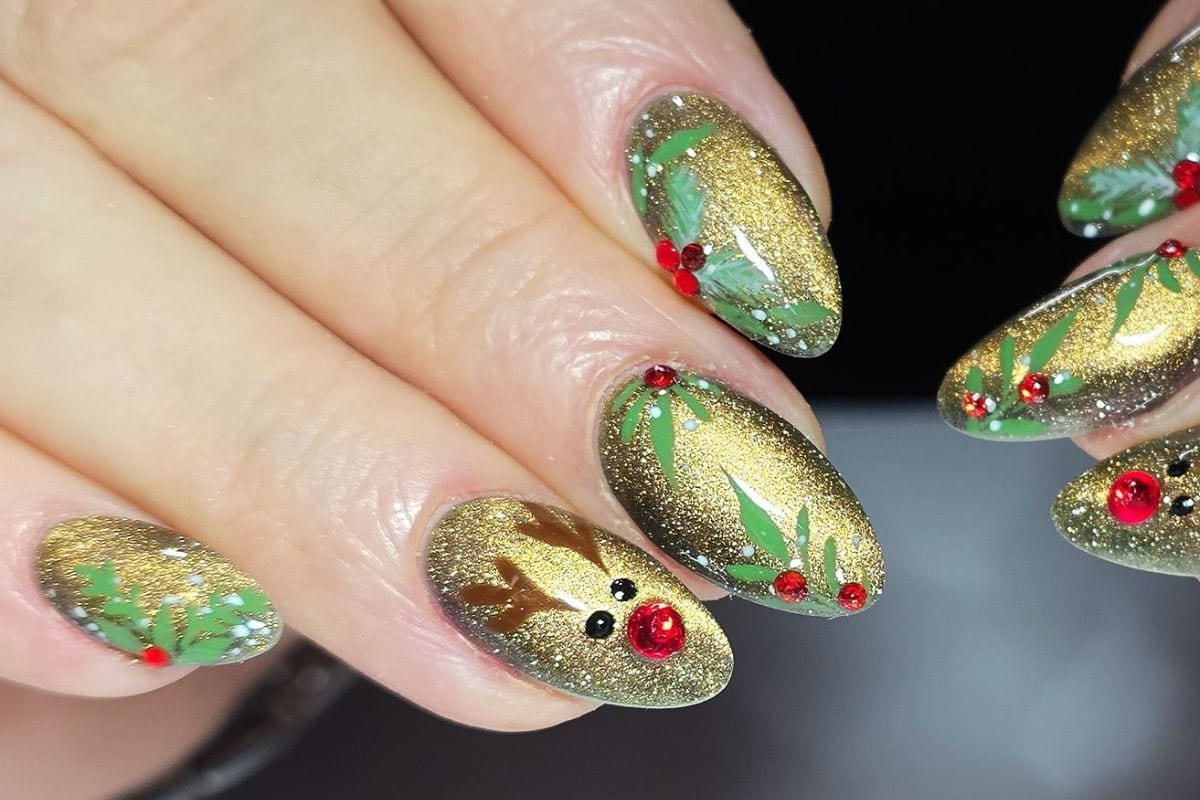
Cat eye nails are a modern manicure technique defined by one unmistakable feature: a glowing, light-shifting line that seems to move as the hand turns. For readers searching for clarity, the answer is simple. Cat eye nails are created using magnetic nail polish infused with metallic particles that respond to a magnet, forming patterns reminiscent of a cat’s reflective eye. The effect is dimensional, fluid, and striking less about color alone and more about movement and depth.
What separates cat eye nails from metallic or chrome finishes is intention. The design is not painted but pulled into shape. Before the polish cures, a magnet is held close to the nail, guiding microscopic particles into soft arcs, sharp beams, or halo-like glows. Once set, the pattern remains fixed, yet visually dynamic, shifting under different angles of light.
Over the past decade, this manicure has evolved from a technical curiosity into a beauty mainstay. Once limited to specialized salons, cat eye nails are now widely available through professional gel systems, at-home kits, and even press-on formats. Social platforms accelerated this rise, turning the magnet-over-polish moment into a form of visual theater that translates perfectly to short-form video.
In a beauty culture that increasingly values personalization, cat eye nails endure because no two sets are identical. Each magnet placement, hand movement, and lighting condition subtly changes the outcome. The manicure offers both control and unpredictability a balance that mirrors contemporary fashion itself, where polish and individuality are no longer opposing ideas but partners.
Origins and Evolution of Cat Eye Nails
The roots of cat eye nails can be traced to early experiments with magnetic pigments in cosmetic products during the late 2000s. Nail manufacturers discovered that metallic particles suspended in lacquer could be manipulated using magnets, initially producing simple striped effects. These early versions were novelty items intriguing but limited in refinement.
By the early 2010s, professional nail technicians in Eastern Europe and East Asia began refining the technique. Gel formulations allowed for slower setting times, giving artists greater control over particle movement. The result was a smoother, gemstone-like finish, often compared to tiger’s eye quartz or polished onyx.
As with many modern beauty trends, social media served as an accelerant rather than an origin. High-definition close-ups made the reflective effect irresistible on screens, while tutorials demystified the process. What once required specialized training became accessible to enthusiasts willing to practice.
By the mid-2020s, cat eye nails had entered a new phase. Celebrities adopted them for red-carpet appearances, designers incorporated them into editorial shoots, and brands diversified color ranges far beyond classic black and emerald. Today, cat eye nails sit comfortably between trend and staple recognizable, adaptable, and technically intriguing.
How Cat Eye Nails Work: The Science Behind the Effect
At the heart of cat eye nails is a straightforward scientific principle: magnetism. The polish contains ferromagnetic particles often iron-based that move in response to a magnetic field. When a magnet is held near the nail, these particles align along invisible magnetic lines, forming concentrated areas of pigment.
Unlike glitter polish, where particles are fixed randomly, magnetic particles remain mobile until cured. This window of movement allows nail artists to sculpt light itself compressing pigment into a single luminous stripe or dispersing it into soft gradients. Once cured under a UV or LED lamp, the design becomes stable.
The visual depth comes from contrast. The concentrated metallic line reflects more light, while the surrounding base color absorbs it, creating an illusion of dimension. As the viewer’s perspective shifts, so does the intensity of the reflection, giving the manicure its signature kinetic quality.
Different magnets produce different effects. Straight magnets create linear beams; curved magnets generate crescent shapes; multi-pole magnets allow for complex, layered designs. Mastery lies not only in magnet choice, but in timing, distance, and angle variables that make each manicure subtly unique.
Types of Cat Eye Nail Products
| Product Type | Key Characteristics | Ideal For |
|---|---|---|
| Gel Magnetic Polish | Requires curing lamp, high shine, long wear | Professional salons |
| Regular Magnetic Polish | Air-dry, easier removal | Beginners |
| Press-On Cat Eye Nails | Pre-designed, reusable | Quick application |
| Hybrid Gel Systems | Flexible wear, enhanced durability | At-home enthusiasts |
The expansion of product formats has played a significant role in the trend’s longevity. While salon gel systems remain the gold standard for intensity and durability, at-home options have lowered the barrier to entry. Press-on versions, in particular, reflect a broader shift toward convenience without sacrificing visual impact.
Expert Perspectives on Technique and Craft
Professional nail artists consistently emphasize that cat eye nails reward patience. According to industry educators, the most common mistake is rushing the magnet step. Holding the magnet too far away results in weak definition; holding it too close can distort the pattern.
Another critical factor is base color selection. Dark bases amplify contrast and depth, while lighter bases create a softer, more ethereal effect. This versatility explains why cat eye nails appear across seasonal trends from moody winter palettes to translucent summer pastels.
Experts also note that the manicure’s appeal lies in its balance of precision and chance. While the technique can be learned, complete replication is nearly impossible. This unpredictability, rather than being a flaw, has become a defining feature.
Design Variations and Aesthetic Directions
Cat eye nails have expanded far beyond the classic diagonal streak. Contemporary interpretations include vertical beams that elongate the nail, circular halos centered on the cuticle, and layered effects that combine multiple magnetic passes.
Minimalist designs pair neutral bases with subtle metallic lines, aligning with understated fashion aesthetics. At the opposite end of the spectrum, maximalist versions incorporate embellishments, color gradients, or negative space, pushing the manicure into expressive territory.
Seasonal adaptations are common. Cooler months favor deep greens, plums, and blacks, while warmer seasons introduce champagne, rose gold, and milky finishes. The technique adapts without losing its core identity, a rare quality in trend-driven beauty.
Cultural Impact and Digital Amplification
The rise of cat eye nails mirrors broader changes in how beauty trends circulate. Short-form video platforms reward transformations that unfold in real time, and the magnet moment delivers precisely that. Viewers watch as an ordinary polish becomes something dimensional within seconds.
This visual immediacy has helped cat eye nails cross cultural boundaries. Tutorials transcend language, relying instead on universally understood gestures and results. The manicure’s global appeal reflects a shift toward beauty practices that are both performative and personal.
Celebrity adoption further legitimized the look, but its endurance comes from everyday wearers. Office-appropriate versions coexist with avant-garde designs, allowing the trend to move fluidly between contexts without losing relevance.
Takeaways
- Cat eye nails use magnetic polish to create light-responsive designs.
- The effect is shaped, not painted, using controlled magnet placement.
- Gel formulations offer the strongest and longest-lasting results.
- Design variations range from minimalist to highly expressive.
- Social media accelerated adoption but did not define the technique.
- Each manicure is inherently unique due to particle movement.
- The trend endures because it balances innovation with wearability.
Conclusion
Cat eye nails represent more than a fleeting beauty moment. They are an example of how technology, artistry, and personal expression intersect in modern grooming. By transforming a simple manicure into an interactive visual experience, the technique challenges traditional ideas of what nail art can be.
Their continued popularity suggests a deeper shift in beauty culture one that values dimension over flatness, movement over static design, and individuality over replication. Whether worn as a subtle accent or a bold statement, cat eye nails adapt to the wearer rather than the other way around.
As trends cycle faster than ever, the staying power of cat eye nails lies in their flexibility. They can be dramatic or restrained, technical or intuitive. In a landscape crowded with novelty, that quiet versatility may be their most enduring quality.
FAQs
What makes cat eye nails different from chrome nails?
Cat eye nails use magnetic particles to create shifting patterns, while chrome nails rely on reflective powder for a uniform mirror finish.
Do cat eye nails require a UV lamp?
Gel versions do, but regular magnetic polishes and press-ons do not require curing lamps.
How long do cat eye gel nails last?
With proper application and care, they typically last two to three weeks.
Can beginners do cat eye nails at home?
Yes. Starter kits include magnets and simplified formulas, though practice improves results.
Are cat eye nails suitable for short nails?
Yes. Vertical or centered magnetic designs can enhance the appearance of shorter nails
References
Allure. (2024). Cat-eye nails: What to know about the magnetic manicure trend. https://www.allure.com
Vogue. (2024). Why cat-eye nails keep returning to fashion. https://www.vogue.com
Glamour. (2023). The science behind magnetic nail polish. https://www.glamour.com
Byrdie. (2023). Cat-eye nails: How they work and how to wear them. https://www.byrdie.com
Harvard University. (2022). Magnetism and materials science explained. https://www.harvard.edu