
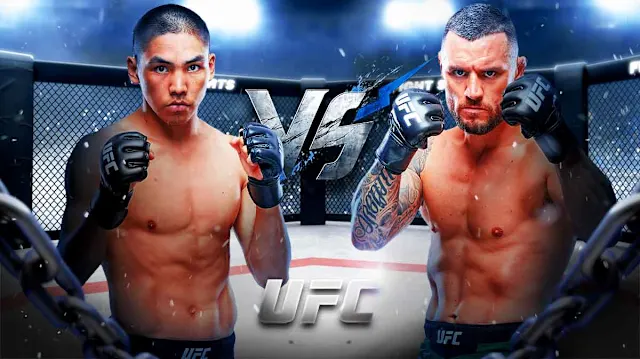
Predictions are the currency of modern combat sports. Odds makers refine them with algorithms, analysts dress them in narrative, and fans consume them as a way to make sense of a fundamentally unpredictable spectacle. When Taiyilake Nueraji faced Kiefer Crosbie at UFC Fight Night in Shanghai, the forecast appeared unusually stable. A young, physically imposing prospect with a history of early finishes was matched against a veteran struggling to gain footing inside the promotion. The expected result was a Nueraji win, likely inside the distance, likely early.
That prediction proved correct in the narrowest sense. Nueraji won by first-round technical knockout. Yet almost immediately, the fight escaped the neat boundaries of prediction models and betting slips. An illegal knee to a grounded opponent, a controversial decision to allow the bout to continue, and Crosbie’s subsequent claims about inadequate medical care turned a seemingly straightforward outcome into a flashpoint discussion.
In the first hundred seconds after the finish, social media and MMA media shifted from praising Nueraji’s power to questioning regulatory safeguards. The fight became less about who won and more about how the win was allowed to happen. This article examines the Nueraji vs. Crosbie prediction not simply as a betting exercise, but as a lens into how mixed martial arts balances analytics, human judgment, and risk. Using pre-fight expectations, in-cage reality, and post-fight consequences, the bout illustrates why correct predictions can still produce uncomfortable truths.
The Predictive Context: Why Nueraji Was Favored
Before the event, the predictive logic surrounding Nueraji vs. Crosbie was rooted in measurable disparity. Nueraji was younger, taller, and longer. His professional record showed a consistent pattern: early pressure, explosive striking, and a high probability of first-round finishes. In contrast, Crosbie entered the bout with significant experience but diminishing momentum, having failed to secure a win in his prior UFC appearances.
Age alone mattered. At 24, Nueraji represented the archetype of the modern UFC prospect athletically primed, aggressively coached, and entering the promotion during his physical peak. Crosbie, at 35, carried the wear of long training camps and competitive mileage. Sports performance research consistently shows decline in reaction time and recovery with age, particularly in high-impact sports.
Reach and frame compounded the advantage. Nueraji’s longer reach allowed him to strike without entering Crosbie’s preferred range, while his size supported top control once the fight hit the mat. Even Crosbie’s strong takedown defense metrics could not offset the probability of absorbing damage during scrambles. From a predictive standpoint, this was not a “coin-flip” fight. It was a calculated expectation of domination. The question was never who would win, but how quickly.
Statistical Comparison Before the Bell
| Metric | Taiyilake Nueraji | Kiefer Crosbie |
|---|---|---|
| Age | 24 | 35 |
| Height | 6’2” | 5’10” |
| Reach | 75 in | 70 in |
| Pro Record | 12–1 | 10–6 |
| UFC Record | Debut win | 0–2 |
| Finish Rate | High (mostly Round 1) | Moderate |
| Primary Strength | Power striking | Experience, durability |
Statistics do not fight for athletes, but they shape expectations. In this case, they aligned with the visual reality of the matchup. The numbers suggested pressure, damage, and a short night for Crosbie.
Fight Night Reality: When Predictions Meet the Octagon
From the opening exchange, the fight unfolded as forecast. Nueraji advanced with confidence, closed distance, and imposed his physicality. Crosbie circled, attempted to manage range, and looked for opportunities to reset. Within minutes, Nueraji secured dominant positions, landing strikes that visibly affected Crosbie. Then came the moment that changed the narrative. As Crosbie was grounded, Nueraji delivered a knee that violated the unified rules of mixed martial arts. The referee immediately recognized the foul and deducted two points an unusually severe but technically justified penalty. What followed was a brief medical pause, after which Crosbie was allowed to continue.
This decision, more than the knee itself, became the focal point of controversy. The rules permit up to five minutes for recovery after a foul, yet fighters often continue sooner if cleared. Crosbie resumed the bout, but his body language suggested compromise. Moments later, Nueraji finished the fight with ground strikes. The prediction had been correct. The process had not been clean.
A Table of Outcome Versus Expectation
| Element | Pre-Fight Expectation | Actual Outcome |
|---|---|---|
| Winner | Nueraji | Nueraji |
| Method | KO/TKO | TKO |
| Round | Early | Round 1 |
| Controversy | Minimal | Illegal knee, officiating debate |
| Narrative Aftermath | Prospect ascends | Safety and regulation questioned |
Expert Perspectives on Prediction and Risk
Several recurring themes emerged in expert commentary following the bout. One concerned the limits of prediction models. While analysts accurately foresaw Nueraji’s dominance, models do not account for fouls, referee discretion, or medical decision-making. These human variables can dramatically alter both outcome and perception. Another theme involved fighter safety. Combat sports operate in a space where harm is inherent, but regulated. Experts in sports medicine and officiating have long argued that recovery windows after fouls exist to protect fighters from cumulative trauma. Allowing a compromised athlete to continue may preserve the show, but it raises ethical questions.
Finally, the bout highlighted reputational risk. For Nueraji, a win should have elevated his standing. Instead, it arrived with an asterisk in public discourse. For Crosbie, the loss compounded concerns about long-term health and career sustainability. Predictions, experts noted, must be evaluated not only on accuracy but on consequence.
The Aftermath: Careers at a Crossroads
In the days following the fight, Crosbie spoke publicly about his dissatisfaction with how the situation was handled. He described lingering symptoms consistent with concussion and criticized the post-fight care he received. Whether all claims withstand scrutiny is less important than what they reveal: fighters often feel powerless once the cage door closes. For Crosbie, the bout may represent an inflection point. At 35, with multiple losses and growing health concerns, his future in the UFC appears uncertain. Fighters in similar positions often transition to regional promotions, coaching, or retirement.
For Nueraji, the victory still counts. His record improves, his highlight reel grows, and his marketability particularly in Asia remains strong. Yet future opponents, referees, and fans will view him through a more complex lens. Discipline and rule awareness will matter as much as power.
Prediction as a Cultural Practice in MMA
The Nueraji vs. Crosbie fight underscores how prediction functions culturally within MMA. It is not merely about gambling or forecasting. Prediction shapes narratives before and after competition. When correct, it reinforces belief in data-driven analysis. When complicated by controversy, it exposes the sport’s unresolved tensions. Mixed martial arts sells authenticity real fights, real consequences. But authenticity does not eliminate responsibility. As predictive tools grow more sophisticated, the sport must ensure that human safeguards evolve alongside them. Otherwise, accurate predictions may continue to coexist with preventable harm.
Takeaways
- Predictions accurately identified Nueraji as the likely winner based on age, size, and finishing ability.
- The fight’s controversy stemmed not from the result, but from how rules were enforced mid-bout.
- Illegal strikes introduce variables that predictive models cannot capture.
- Fighter safety protocols remain a point of tension between competition and care.
- Correct predictions do not guarantee clean narratives.
- Career trajectories can be altered as much by controversy as by defeat.
Conclusion
The story of Nueraji vs. Crosbie is not one of failed prediction. It is, in fact, a story of prediction fulfilled and then complicated. The numbers were right. The analysts were right. The outcome followed the expected arc. Yet the fight revealed how fragile that arc can be when human judgment intervenes. Mixed martial arts thrives on certainty colliding with chaos. Predictions offer structure, but the sport resists being fully contained by them. Fouls happen. Referees decide. Fighters absorb damage that statistics cannot measure. In that space, accuracy becomes only one measure of success.
As the UFC continues to globalize and professionalize, bouts like this serve as reminders that the future of the sport depends not just on better predictions, but on better systems to manage what predictions cannot foresee.
FAQs
Was the Nueraji vs. Crosbie prediction accurate?
Yes. Most analysts correctly predicted a Nueraji victory, likely by early stoppage.
Why was the fight controversial despite the correct prediction?
An illegal knee and the decision to allow Crosbie to continue raised concerns about officiating and safety.
Did the point deduction affect the outcome?
No. Despite a two-point deduction, Nueraji still won via first-round TKO.
What does this fight mean for Crosbie’s career?
It places his UFC future in doubt, particularly given age and health concerns.
Does controversy change how predictions are evaluated?
Yes. Predictions must be assessed not only on results but on their broader consequences.
References
UFC. (2025). Taiyilake Nueraji athlete profile. Ultimate Fighting Championship. https://www.ufc.com
UFC. (2025). Kiefer Crosbie athlete profile. Ultimate Fighting Championship. https://www.ufc.com
MMA Fighting. (2025). UFC Shanghai fight recap and officiating analysis. https://www.mmafighting.com
DraftKings Network. (2025). Fight prediction and betting analysis for UFC Shanghai. https://dknetwork.draftkings.com
Association of Ringside Physicians. (2023). Medical guidelines for combat sports. https://www.ringsidearp.org