
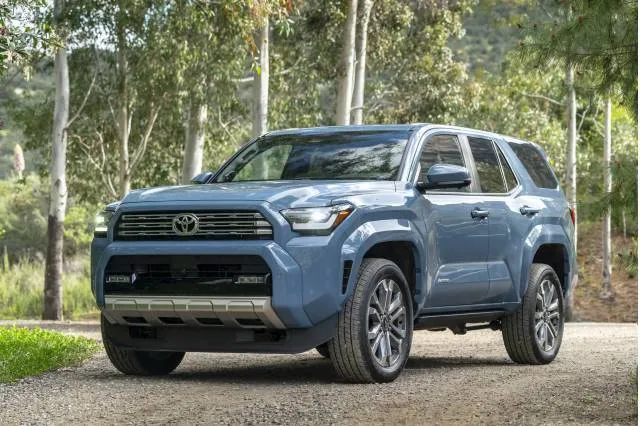
The 2025 Toyota 4Runner arrives as one of the most consequential redesigns in the nameplate’s four-decade history. In its first full generational update in years, Toyota has not merely refreshed an aging SUV; it has rethought what a midsize, body-on-frame vehicle should represent in an era shaped by electrification, digital interfaces, and evolving consumer expectations. Within the first moments of examining the new model, it becomes clear that Toyota’s goal was not to abandon the 4Runner’s identity, but to future-proof it.
At its core, the 2025 4Runner remains a rugged, adventure-focused SUV engineered for durability and off-road confidence. Yet it now speaks the language of modern drivers. Turbocharged engines replace the long-serving naturally aspirated V6. A hybrid powertrain enters the lineup for the first time. The interior is reshaped around large digital displays, advanced safety systems, and improved materials. All of this unfolds on Toyota’s new TNGA-F platform, shared with the latest Tacoma and Land Cruiser, signaling a unification of Toyota’s truck and SUV philosophy.
For loyalists, the promise is continuity: body-on-frame construction, available four-wheel drive, and signature design elements like the power rear window remain intact. For new buyers, the promise is relevance better efficiency, more torque, improved on-road manners, and technology that no longer feels behind the curve. The 2025 Toyota 4Runner thus stands at an intersection, attempting to satisfy tradition without resisting change, and in doing so, redefining what longevity looks like in a competitive SUV market.
A Brief Legacy: Why the 4Runner Matters
Since its introduction in the mid-1980s, the Toyota 4Runner has occupied a unique place in the American automotive landscape. It was never the most luxurious SUV, nor the most fuel-efficient, but it earned a reputation for durability that bordered on myth. Owners kept their vehicles for decades, passing them down or pushing them well beyond 200,000 miles. The 4Runner became shorthand for reliability, particularly among outdoor enthusiasts, off-roaders, and buyers who valued mechanical simplicity over trend-driven design.
By the early 2020s, however, the formula that once defined the 4Runner began to show its age. Competitors introduced advanced driver-assistance systems, turbocharged engines, and electrified powertrains, while the outgoing 4Runner retained an old-school V6 and relatively dated interior technology. Sales remained strong, but expectations were shifting. Toyota faced a dilemma: modernize too aggressively and risk alienating loyal customers, or evolve too slowly and lose relevance.
The 2025 model represents Toyota’s answer to that dilemma. Rather than reimagining the 4Runner as a crossover, Toyota doubled down on its truck-based roots while upgrading nearly every supporting system around them. This strategy places the new 4Runner not as a nostalgic relic, but as a contemporary interpretation of rugged utility.
Platform and Engineering: The TNGA-F Foundation
At the heart of the 2025 Toyota 4Runner is the TNGA-F platform, Toyota’s global body-on-frame architecture designed for trucks and large SUVs. This platform is already in use under the latest Tacoma, Tundra, Sequoia, and Land Cruiser, and its adoption marks a structural leap forward for the 4Runner.
The TNGA-F platform improves torsional rigidity while reducing unnecessary weight, allowing engineers to fine-tune suspension geometry for better ride quality without sacrificing strength. On pavement, this translates into improved stability and reduced body roll. Off-road, it provides a sturdier foundation for articulation, wheel travel, and underbody protection.
Equally important is what the platform enables: powertrain flexibility. By designing the 4Runner around TNGA-F, Toyota created space for turbocharged engines, hybrid systems, and advanced electronic controls that would have been difficult to integrate into the outgoing architecture. The result is a vehicle that feels both tougher and more sophisticated, a balance that underpins nearly every aspect of the 2025 redesign.
Powertrains: From Old-School V6 to Hybrid Torque
One of the most discussed changes in the 2025 Toyota 4Runner is the departure from its long-running 4.0-liter V6 engine. In its place are two variations of a 2.4-liter turbocharged four-cylinder engine, signaling Toyota’s broader shift toward smaller, more efficient, yet more powerful powertrains.
The standard i-FORCE turbo engine delivers 278 horsepower and 317 lb-ft of torque, figures that surpass the outgoing V6 in both responsiveness and efficiency. Paired with an eight-speed automatic transmission, the new setup offers smoother acceleration and better highway performance, addressing long-standing criticisms of the older model’s driving dynamics.
For the first time in 4Runner history, Toyota also offers a hybrid option. The i-FORCE MAX hybrid pairs the same turbocharged engine with an electric motor integrated into the transmission. Combined output rises to 326 horsepower and an impressive 465 lb-ft of torque. This torque figure is particularly significant, enhancing low-speed crawling capability off-road and improving towing confidence.
Powertrain Comparison Overview
| Specification | i-FORCE Turbo | i-FORCE MAX Hybrid |
|---|---|---|
| Engine Type | 2.4L turbocharged inline-4 | 2.4L turbo + electric motor |
| Horsepower | 278 hp | 326 hp |
| Torque | 317 lb-ft | 465 lb-ft |
| Transmission | 8-speed automatic | 8-speed automatic |
| Drivetrain | RWD / 4WD | RWD / 4WD |
| Max Towing (approx.) | ~5,000 lbs | Up to ~6,000 lbs |
Design Evolution: Ruggedness Refined
Visually, the 2025 4Runner communicates confidence without resorting to excess. The exterior design is sharper and more sculpted than before, with a bolder front fascia, squared-off wheel arches, and modern LED lighting. Yet the proportions remain unmistakably 4Runner upright, muscular, and purpose-driven.
Toyota intentionally preserved heritage cues. The power-operated rear window, a hallmark feature beloved by owners, remains. The rear quarter glass echoes earlier generations, and the overall stance avoids the sloping rooflines common among crossovers. This is not an SUV trying to disguise itself as something else.
Inside, the transformation is more pronounced. The dashboard centers around a large touchscreen up to 14 inches paired with a fully digital instrument cluster. Physical controls remain for critical functions, a nod to usability in off-road or gloved-hand scenarios. Materials improve across the board, especially in higher trims, where soft-touch surfaces, contrast stitching, and premium upholstery elevate the cabin experience.
Technology and Safety: Catching Up and Then Some
For years, technology was the area where the 4Runner lagged behind competitors. The 2025 model closes that gap decisively. Toyota Safety Sense 3.0 comes standard, bringing features such as adaptive cruise control, lane tracing assist, automatic emergency braking with pedestrian detection, and road sign recognition.
Off-road technology also receives attention. Available Multi-Terrain Select systems adjust throttle response, braking, and traction control depending on surface conditions. The Multi-Terrain Monitor uses cameras to provide a real-time view of obstacles around the vehicle, a feature particularly valuable during technical trail driving.
Connectivity improves with wireless Apple CarPlay and Android Auto, over-the-air update capability, and enhanced voice recognition. These changes reflect Toyota’s acknowledgment that modern buyers expect digital fluency even in rugged vehicles.
Trim Strategy: Broadening the 4Runner Audience
The 2025 4Runner lineup expands to accommodate a wider range of buyers, from entry-level adventurers to premium-oriented customers. Traditional trims like SR5 and Limited remain, but Toyota introduces new identities to reflect different lifestyles.
The TRD Off-Road and TRD Pro trims continue to anchor the lineup for enthusiasts, offering locking differentials, skid plates, and specialized suspension tuning. New for this generation is the Trailhunter trim, designed with overlanding in mind. Factory-installed equipment such as heavy-duty roof racks, auxiliary lighting, and off-road suspension components cater to buyers who want expedition readiness without aftermarket modifications.
At the top end, Platinum trims pair the hybrid powertrain with upscale materials and advanced features, positioning the 4Runner as a legitimate alternative to luxury SUVs for buyers who still want real off-road capability.
Trim Positioning Overview
| Trim | Primary Focus |
|---|---|
| SR5 | Entry-level capability and value |
| TRD Sport | On-road style and performance |
| TRD Off-Road | Trail-focused hardware |
| TRD Pro | Maximum factory off-road performance |
| Trailhunter | Overlanding and expedition use |
| Limited / Platinum | Comfort, technology, refinement |
Expert Perspectives on the 2025 Shift
Industry analysts have widely interpreted the 2025 4Runner as a strategic pivot rather than a simple redesign. One recurring theme in expert commentary is Toyota’s emphasis on torque and efficiency over raw displacement. The hybrid system’s torque output, in particular, is seen as a meaningful upgrade for both towing and off-road driving.
Another point of praise is platform sharing. By aligning the 4Runner with the Tacoma and Land Cruiser, Toyota benefits from economies of scale while ensuring consistent engineering standards across its truck-based lineup. Experts also note that retaining body-on-frame construction differentiates the 4Runner in a segment increasingly dominated by unibody crossovers.
Criticism, where it exists, tends to focus on pricing and complexity. As the 4Runner becomes more technologically advanced, it also becomes more expensive and less mechanically simple a trade-off that may concern some long-time owners.
Market Context: Competition and Consumer Expectations
The midsize SUV market has evolved dramatically. Buyers now compare the 4Runner not only with traditional rivals but also with crossovers offering smoother rides and better fuel economy. Toyota’s decision to modernize while preserving core attributes positions the 4Runner as a niche leader rather than a mass-market compromise.
Early consumer reactions suggest strong interest, particularly in hybrid and Trailhunter variants. At the same time, there is cautious skepticism among purists who valued the outgoing model’s simplicity. This tension reflects a broader industry reality: progress often requires redefining what loyalty looks like.
Takeaways
- The 2025 Toyota 4Runner marks the first full generational redesign in years.
- Turbocharged and hybrid powertrains replace the long-standing V6.
- TNGA-F platform improves rigidity, ride quality, and powertrain flexibility.
- Interior technology and safety systems are now competitive with modern rivals.
- Expanded trim lineup targets diverse lifestyles, from overlanding to premium comfort.
- The redesign balances tradition with necessary modernization.
Conclusion
The 2025 Toyota 4Runner is not simply a new model year it is a statement about how legacy vehicles can evolve without losing their soul. Toyota has chosen a careful path, one that preserves the 4Runner’s identity as a durable, body-on-frame SUV while acknowledging that durability alone is no longer enough. Efficiency, technology, comfort, and versatility now matter just as much.
For some, the loss of the old V6 and the embrace of hybridization may feel like the end of an era. For others, the added torque, improved driving dynamics, and modern features represent long-overdue progress. What is clear is that Toyota has positioned the 4Runner not as a nostalgic holdover, but as a forward-looking vehicle designed to remain relevant for decades to come. In doing so, the 2025 4Runner reaffirms that evolution, when done thoughtfully, can be a form of respect.
FAQs
Is the 2025 Toyota 4Runner still body-on-frame?
Yes. The 2025 4Runner retains body-on-frame construction using Toyota’s TNGA-F platform.
Does the 2025 4Runner offer a hybrid option?
Yes. The i-FORCE MAX hybrid is available and standard on select higher trims.
What happened to the V6 engine?
Toyota replaced the naturally aspirated V6 with turbocharged four-cylinder engines for better efficiency and torque.
Is the 2025 4Runner good for off-roading?
Absolutely. It offers multiple 4WD systems, off-road trims, and advanced trail technology.
How does it compare to the previous generation?
The new model is more powerful, more efficient, and significantly more technologically advanced.
References
Toyota Motor Corporation. (2024).
Toyota Motor North America. (2024). 4Runner product history and engineering philosophy. Toyota Pressroom.
Kelley Blue Book. (2024). Midsize SUV market analysis and consumer trends. Kelley Blue Book Automotive Research.
Edmunds. (2024). Body-on-frame SUVs in a crossover market. Edmunds Industry Insights.
Car and Driver. (2024). Hybridization trends in off-road vehicles. Car and Driver Magazine.