
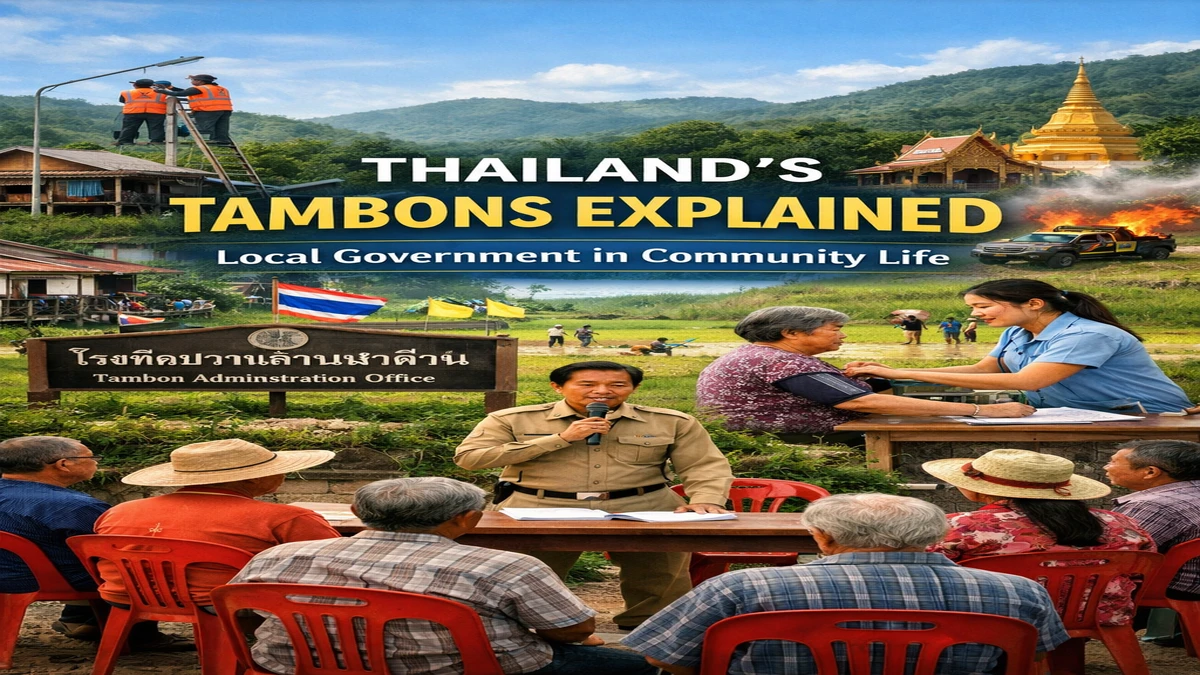
Tumbons commonly spelled tambon form one of the most essential yet often overlooked layers of Thailand’s administrative system. In the first moments of understanding, readers should know that a tumbon is a subdistrict, positioned below districts (amphoe) and provinces (changwat), and represents the primary interface between national governance and everyday community life. For millions of residents, the tambon is where roads are maintained, local disputes are addressed, development budgets are debated, and cultural traditions are sustained.
Beyond administrative terminology, tumbons function as lived spaces. They are the level of governance closest to the village, where elected representatives and local leaders respond to tangible needs rather than abstract policy goals. Each tumbon typically encompasses several villages (muban), linking households into a shared civic framework. This structure allows national directives to be adapted to local realities, from agricultural priorities to infrastructure maintenance.
Understanding tumbons is critical to understanding Thailand itself. They reflect the country’s long-standing effort to balance centralized authority with local autonomy. As Thailand urbanizes and rural areas transform, tumbons continue to evolve, absorbing new responsibilities while retaining deep historical continuity. This article explores tumbons not simply as bureaucratic units, but as social institutions that shape participation, resilience, and identity across the country.
Historical Origins of the Tambon System
The roots of the tambon system extend back to pre-modern Siam, when communities organized themselves around agriculture, kinship, and shared resources. These early settlements naturally formed clusters that later became the basis for formal administrative divisions. When Thailand embarked on state modernization in the late nineteenth and early twentieth centuries, these organic groupings were formalized into a standardized hierarchy.
Administrative reforms introduced a clear territorial structure composed of provinces, districts, and subdistricts. Tambons emerged as the critical middle ground between district authorities and village leadership. Rather than dismantling traditional community bonds, the system incorporated them, allowing local leaders to remain influential while operating within a national framework.
Over time, tambons transitioned from informal community identifiers into legally recognized administrative entities. Their endurance reflects both practicality and cultural alignment. By grounding governance in familiar social units, the state ensured greater compliance, legitimacy, and administrative reach. Today’s tambons are thus products of both historical continuity and bureaucratic evolution.
Administrative Structure and Governance
Within Thailand’s administrative hierarchy, tambons operate directly under district authority. Each tambon typically contains multiple villages, each led by a village head who serves as the first point of contact between residents and government. At the tambon level, governance is primarily exercised through Tambon Administrative Organizations, commonly known as Or Bor Tor.
These organizations are locally elected, granting residents direct influence over leadership and priorities. Responsibilities include infrastructure development, sanitation, land-use planning, local regulations, and community services. While their authority is limited compared to districts or provinces, Or Bor Tor bodies play a decisive role in shaping daily life.
Coordination is a defining feature of tambon governance. While budgets and policies are influenced by higher administrative levels, implementation is localized. This layered model allows national standards to be enforced while still accommodating local variation. Tambons therefore function as translators of policy, converting centralized objectives into context-appropriate action.
Tambons and Everyday Community Life
For residents, the tambon is the most visible face of government. Roads, drainage systems, community centers, and public spaces are often managed at this level. When infrastructure fails or improvements are needed, it is the tambon administration that residents approach first.
Tambons also play a role in education support, public health outreach, environmental management, and cultural activities. Although major institutions such as schools and hospitals may fall under district or provincial control, tambon authorities facilitate coordination and provide supplementary resources. Health campaigns, disaster preparedness, and environmental conservation efforts often depend on tambon-level organization.
Civic participation is another defining feature. Public meetings, budget discussions, and local elections create opportunities for residents to engage directly with governance. This proximity fosters accountability and reinforces the tambon as a shared civic space rather than a distant administrative abstraction.
Urbanizing Tambons and Municipal Transformation
While tambons are frequently associated with rural life, many now exist within expanding urban and peri-urban regions. As population density increases and economic activity diversifies, governance structures adapt accordingly. Some tambons transition into subdistrict municipalities, reflecting their expanded responsibilities and resource needs.
Urbanizing tambons face distinct challenges. Infrastructure demands intensify, land use becomes more complex, and service expectations rise. Traditional village-based coordination must coexist with more formal bureaucratic processes. This transformation tests the flexibility of the tambon system but also demonstrates its resilience.
Despite these pressures, the core function remains consistent: mediating between residents and the state. Whether rural or urban, tambons continue to anchor governance in locality, ensuring that development does not entirely detach from community context.
Comparative Administrative Overview
| Administrative Level | Role in Governance |
|---|---|
| Province | Regional coordination and policy oversight |
| District | Implementation and supervision of subdistricts |
| Tambon | Local services, infrastructure, civic participation |
| Village | Community leadership and civil registration |
| Aspect | Rural Tambon | Urban or Peri-Urban Tambon |
|---|---|---|
| Population | Lower density | Higher density |
| Governance Form | Or Bor Tor | Municipal administration |
| Primary Focus | Agriculture, basic services | Infrastructure, urban planning |
| Community Interaction | Informal meetings | Structured councils |
Expert Perspectives on Tambon Governance
Scholars of public administration frequently note that decentralization succeeds or fails at the subdistrict level. Tambons are where policies encounter lived reality, making them critical indicators of governance effectiveness. Development specialists emphasize that local participation at the tambon level enhances policy legitimacy and long-term sustainability. Others observe that tambons provide institutional memory, preserving community knowledge even as leadership changes.
These perspectives converge on a central insight: tambons are not peripheral. They are central to how governance is experienced and understood across Thailand.
Takeaways
- Tambons are Thailand’s core subdistrict units connecting state and community
- They combine elected governance with traditional village leadership
- Daily services and infrastructure are managed at the tambon level
- Urbanization is reshaping tambon responsibilities and structures
- Civic participation is strongest where tambon governance is active
- Tambons embody Thailand’s approach to decentralized administration
Conclusion
Tambons occupy a unique and indispensable position in Thailand’s governance landscape. Neither purely administrative nor purely cultural, they represent a hybrid institution shaped by history, necessity, and community practice. Through their evolution from traditional settlements to modern administrative units, tambons have maintained their relevance by adapting to social and economic change.
As Thailand continues to urbanize and decentralization remains a national priority, the tambon will remain a critical testing ground for governance reform. Its strength lies in proximity—its ability to translate policy into practice and community needs into administrative action. In understanding tumbons, one gains insight not only into Thai bureaucracy, but into how governance lives, breathes, and functions at the local level.
FAQs
What is a tumbon?
A tumbon, or tambon, is a subdistrict in Thailand located below districts and provinces.
How are tumbons governed?
They are governed by locally elected Tambon Administrative Organizations or municipal bodies in urban areas.
What services do tumbons provide?
They manage local infrastructure, sanitation, community services, and civic programs.
Are tumbons only rural?
No, many tumbons exist in urban and peri-urban areas and may become municipalities.
Why are tumbons important?
They connect national governance with local needs and enable community participation.
References
- Wikipedia contributors. (2025, January 12). Tambon. Wikipedia. Retrieved from https://en.wikipedia.org/wiki/Tambon Wikipedia
- Wikipedia contributors. (2025, February 15). Administrative divisions of Thailand. Wikipedia. Retrieved from https://en.wikipedia.org/wiki/Administrative_divisions_of_Thailand Wikipedia
- United Nations Economic and Social Commission for Asia and the Pacific (UNESCAP). (n.d.). Tambon Administration Organization. Retrieved from https://www.unescap.org/sites/default/d8files/Bulletin69_Article-2.pdf UNESCAP
- SNG-WOFI. (n.d.). Country and territory profiles — Thailand. Retrieved from https://www.sng-wofi.org/country_profiles/thailand.html SNG WOFI
- Thailand Law Online. (n.d.). Thai Legal Terms — Or Bor Tor (Subdistrict Administrative Organization). Retrieved from https://www.thailandlawonline.com/or-bor-tor thailandlawonline.com