
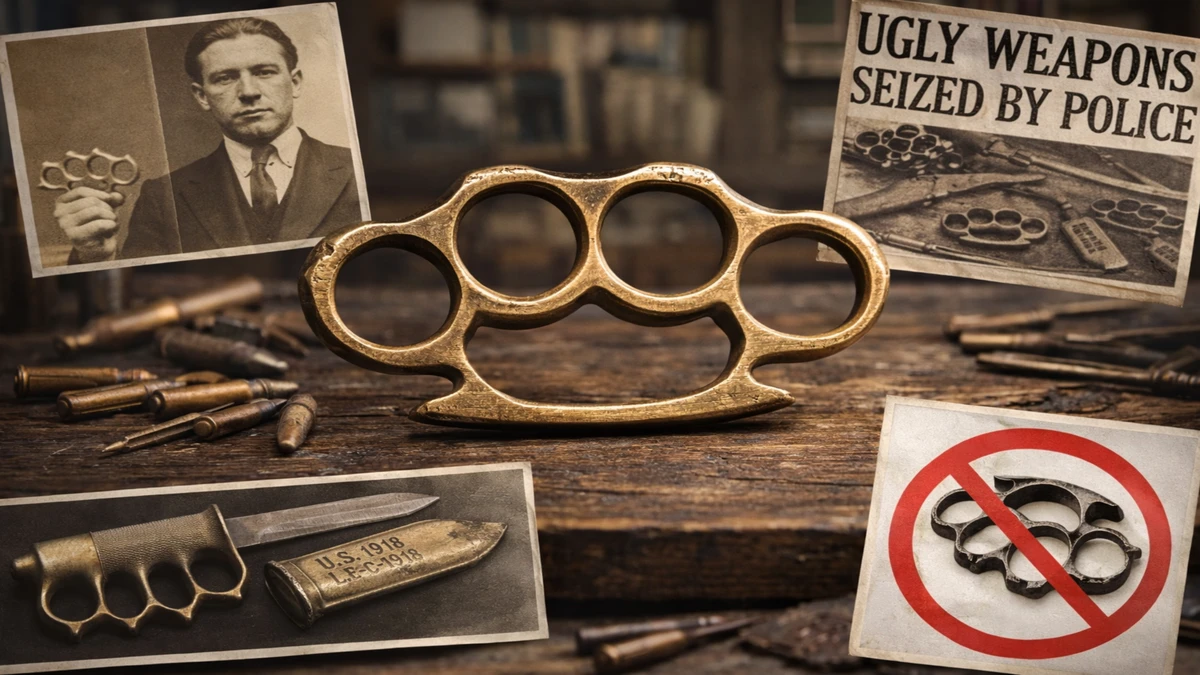
The schlagring, better known in English as brass knuckles or a knuckle-duster, is a fist-held metal device designed to concentrate the force of a punch onto a smaller surface area, intensifying impact and injury. Its purpose is simple, but its implications are not. Over centuries, this object has shifted from battlefield tool to street weapon, from sporting novelty to prohibited item, from cultural symbol to legal problem. To understand the schlagring is to understand how societies draw boundaries around acceptable force, personal defense, and public danger.
In the modern world, most people encounter brass knuckles not as tools of survival but as objects of controversy. They are banned in many countries, regulated in others, and still circulate through subcultures of collectors, martial artists, and fashion designers. They appear in films as shorthand for menace, in music as a symbol of toughness, and in courtrooms as evidence of criminal intent. The schlagring sits at the intersection of design, law, violence, and identity.
This article explores the schlagring’s long history, how it works, why it is feared and regulated, how it has been represented in culture, and what its continued presence says about our relationship with violence and power. The story is not about metal alone, but about the human need to control force and the social systems built to contain it.
Ancient and Pre-Modern Origins
Long before industrial metalworking made mass-produced brass knuckles possible, fighters across cultures sought ways to strengthen their fists. In ancient Greece and Rome, gladiators used the caestus, a leather or metal-reinforced glove designed to increase striking power. In South Asia, practitioners of vajra-mushti used knuckle weapons made from horn, bone, or metal for ritualized combat. These early forms reveal a recurring idea: the human fist, enhanced, becomes a weapon.
These devices were not hidden or criminal in their original contexts. They belonged to structured combat systems, whether in sport, ritual, or war. The schlagring’s ancestry is therefore not inherently illicit. It emerges from a long tradition of human attempts to modify the body for combat efficiency. What changed was not the object’s form, but the social context in which it was used.
By the nineteenth century, as urbanization intensified and personal violence moved from battlefield to street, compact fist weapons became associated less with warriors and more with criminals and gangs. The schlagring migrated from formal combat into informal, often illegal, violence.
Design and Physical Function
The schlagring consists of a solid bar with holes for the fingers, allowing the metal to sit over the knuckles. When a punch is thrown, the metal transfers and concentrates force onto a smaller surface, increasing pressure and damage. At the same time, the bar distributes recoil across the palm, protecting the user’s hand from injury.
This mechanical simplicity is precisely what makes the schlagring powerful and dangerous. It requires no training to use, no ammunition, and little maintenance. It transforms the body into a weapon with minimal effort. That accessibility has always been part of its appeal and part of its threat.
Modern versions vary in material and style, from classic brass or steel to plastic composites and decorative designs. Some include spikes, blades, or integrated tools. Yet the basic principle remains unchanged: amplify the human punch.
The Shift into Illegality
As urban crime rose in the late nineteenth and early twentieth centuries, brass knuckles became associated with street violence, extortion, and gang culture. Lawmakers began to view them not as neutral tools but as instruments of harm with no legitimate civilian purpose. This perception drove legal bans across Europe and North America.
Unlike knives or firearms, which have hunting, sport, or work-related uses, brass knuckles exist almost exclusively to injure another person. That single-purpose nature has shaped their legal treatment. Many jurisdictions classify them as prohibited weapons, making even possession illegal regardless of intent.
This shift reflects a broader legal philosophy: some objects are considered so closely tied to violence that they are regulated not by behavior, but by existence. The schlagring became one of those objects.
Comparative Legal Landscape
| Region | Legal Status | Rationale |
|---|---|---|
| Western Europe | Mostly illegal | Classified as offensive weapons |
| Canada | Illegal | Prohibited weapon category |
| United States | Varies by state | Regulated as concealed or dangerous weapons |
| East Asia | Mixed | Often legal to own, restricted to carry |
| Latin America | Mostly restricted | Linked to street violence |
This patchwork of law reflects different cultural tolerances for risk and different historical experiences with violence. In societies with strong public safety traditions, the schlagring is viewed as an unacceptable threat. In others, it is seen as a minor object unless misused.
Cultural Meaning and Symbolism
The schlagring has long outgrown its physical form to become a symbol. In film and television, it signals danger and criminality. A character who carries brass knuckles is marked as violent before they throw a punch. In music and fashion, the image is used to suggest toughness, rebellion, and resistance to authority.
Collectors and historians, however, see the schlagring differently. For them, it is a material artifact of social history, reflecting how violence has been organized, romanticized, and regulated. The same object can therefore signify menace, nostalgia, or artistry depending on the viewer.
This duality explains why brass knuckles persist even where illegal. They are not just tools but icons, and icons are hard to erase.
Expert Perspectives
A legal scholar specializing in weapons law has described brass knuckles as “one of the clearest examples of an object whose social meaning has overtaken its physical form,” noting that bans often reflect symbolic fears as much as statistical risk.
A historian of arms and armor has argued that the schlagring represents “the democratisation of violence,” because it allows almost anyone to wield disproportionate force without training.
A public safety researcher has pointed out that the injury patterns associated with brass knuckles are disproportionately severe relative to the simplicity of the weapon, supporting the case for regulation.
Violence, Self-Defense, and Ethics
Supporters of legal access sometimes argue that brass knuckles offer a means of self-defense, especially for those unable to physically overpower an attacker. Critics respond that any defensive benefit is outweighed by the risk of escalation and severe injury.
Ethically, the schlagring raises a classic question: does the right to defend oneself include the right to carry tools designed solely to harm? Different legal systems answer this differently, reflecting deeper cultural values about trust, fear, and the role of the state in managing violence.
Body as Weapon, Law as Boundary
The schlagring sits at the boundary between body and weapon. It is not separate from the person using it, like a gun or knife, but an extension of the hand itself. That intimacy makes it psychologically powerful and legally troubling. It blurs the line between natural and artificial violence.
In regulating the schlagring, societies are not just banning an object. They are attempting to draw a boundary around the acceptable limits of human force.
Takeaways
- The schlagring evolved from ancient combat tools into a modern prohibited weapon.
- Its design concentrates force, increasing injury risk significantly.
- Legal treatment varies widely but often reflects cultural attitudes toward violence.
- It functions as both a physical weapon and a cultural symbol.
- Debates about it mirror broader tensions between self-defense and public safety.
- Its persistence shows how symbols of power outlive their practical uses.
Conclusion
The schlagring is small, silent, and simple, yet it carries centuries of human conflict in its curve of metal. It embodies our desire to enhance ourselves, our fear of uncontrolled violence, and our need to regulate the tools we create. Whether seen as a criminal weapon, a historical artifact, or a cultural icon, it forces us to confront uncomfortable questions about how we manage force in society.
By tracing the schlagring’s journey from ritual combat to courtroom evidence, we see not just the history of an object, but the history of our attempts to contain violence without denying human vulnerability. In that sense, the schlagring is not merely a weapon. It is a mirror.
FAQs
What is a schlagring?
It is a metal fist weapon, commonly called brass knuckles, designed to increase the impact of a punch.
Why are brass knuckles illegal in many places?
Because they are considered inherently dangerous and closely associated with violent crime.
Were they always illegal?
No. Similar tools were once used in formal combat and ritualized fighting.
Do people still use them today?
Yes, though mostly illegally, as collectibles, or as cultural symbols.
Are there safer alternatives for self-defense?
Many jurisdictions recommend non-lethal options and situational awareness instead.