
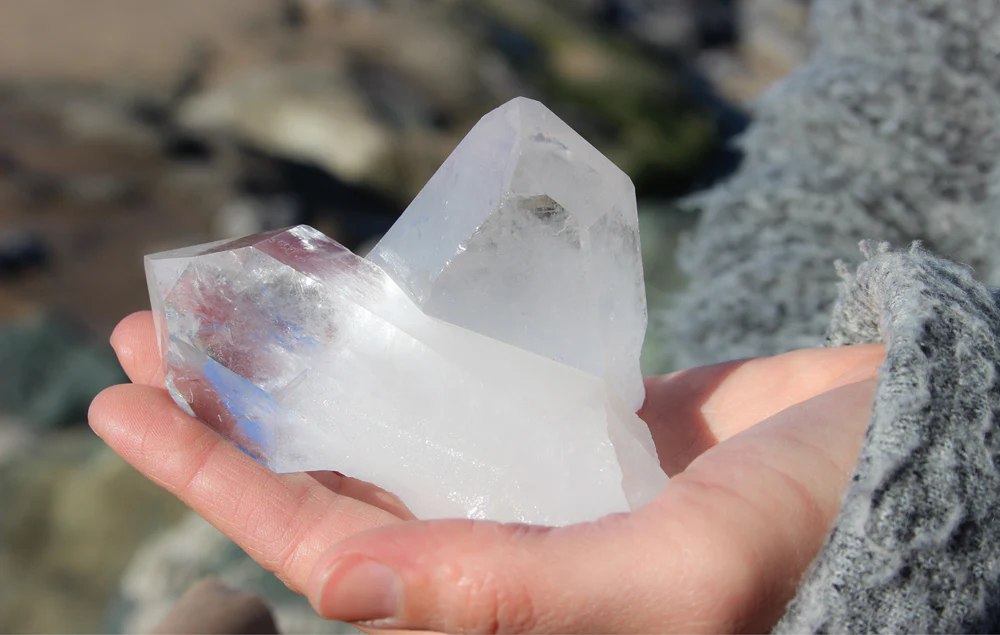
Rock crystal is the clearest and most archetypal expression of quartz, a mineral so common in the Earth’s crust that it often disappears into the background of geology textbooks. Yet when quartz appears in its transparent, colorless form, it captures attention in a way few natural materials can. In the first hundred words, the essential truth is this: rock crystal has mattered to humans for millennia because it unites beauty, durability, symbolism, and utility. Composed of silicon dioxide arranged in a precise atomic lattice, it grows slowly in the dark cavities of the Earth, forming hexagonal prisms that appear almost deliberately shaped.
Historically, people did not understand its chemistry or crystal structure. What they understood was its clarity. To ancient eyes, rock crystal looked like frozen water or solidified light, something caught between the earthly and the divine. That perception carried it into temples, royal treasuries, monasteries, and eventually laboratories. Rock crystal has been carved into ritual vessels, worn as jewelry, mounted into reliquaries, ground into lenses, and sliced into oscillators that regulate modern electronics. Few materials can claim such a continuous presence across religion, art, science, and daily life.
This article traces that long arc. It begins with geology and formation, moves through ancient and medieval meanings, examines the Renaissance shift toward scientific use, and ends in the present, where rock crystal still oscillates between symbol and instrument. Its story is not only about a mineral, but about how humans assign meaning, extract function, and repeatedly rediscover wonder in the natural world.
Geological Foundations: What Rock Crystal Is
Rock crystal is the transparent, colorless variety of quartz, chemically defined as silicon dioxide (SiO₂). Quartz is among the most abundant minerals on Earth, but rock crystal represents its most visually striking form. The absence of impurities gives it its clarity; even trace elements that color amethyst or smoky quartz are missing. The result is a crystal that appears almost unreal, as though carved from air rather than stone.
Formation occurs when silica-rich fluids cool slowly within cavities, fractures, or veins in igneous and metamorphic rocks. Over thousands or millions of years, atoms arrange themselves into a repeating hexagonal lattice, producing the characteristic prismatic crystals with pointed terminations. The slow pace of this process is essential: rapid cooling produces cloudy or microcrystalline quartz, while ideal conditions yield transparency.
Rock crystal has a hardness of 7 on the Mohs scale, making it resistant to scratching and suitable for carving and polishing. At the same time, it fractures conchoidally, breaking in smooth curves rather than jagged edges. These properties made it workable long before modern tools existed. Major deposits occur in Brazil, Madagascar, the Alpine regions of Europe, and parts of the United States, especially Arkansas. Each locality produces crystals with subtle differences in habit and clarity, feeding both scientific study and collector fascination.
Early Human Encounters and Ancient Meaning
Long before mineralogy existed as a discipline, humans responded intuitively to rock crystal. Archaeological evidence suggests that early societies collected and shaped clear quartz for ritual and ornamental purposes. Its transparency set it apart from ordinary stone, inviting interpretation and myth.
In ancient Greece, rock crystal was called krustallos, meaning ice. Philosophers believed it to be water frozen so completely that it could never thaw. This idea was not merely poetic; it reflected an attempt to explain clarity and hardness within the limits of early natural philosophy. The association with ice linked crystal to purity, permanence, and restraint qualities admired in both moral and cosmological thinking.
Egyptians carved quartz into beads, amulets, and small vessels, often associating it with protection and healing. In Mesopotamia, crystal objects appeared in elite contexts, suggesting a material reserved for power and ritual. Across these cultures, rock crystal functioned less as a decorative stone and more as a mediator between visible and invisible worlds. Its physical transparency made it an ideal metaphor for spiritual clarity and divine presence.
Classical and Roman Uses
By the classical period, rock crystal had become firmly established as a luxury material. Greek artisans engraved it into seals and decorative objects, while Roman craftsmen expanded its use into jewelry, tableware, and display pieces. Roman naturalists noted its resistance to heat and its glass-like appearance, often comparing it favorably to manufactured glass, which at the time lacked consistency and clarity.
Elite Romans valued crystal cups and bowls not only for beauty but for symbolism. Drinking from a crystal vessel implied refinement, self-control, and closeness to the natural order. The material’s coolness to the touch reinforced its association with ice and purity. Rock crystal thus operated as a social signal, marking status while reinforcing philosophical ideals of clarity and restraint.
The Roman world also helped disseminate crystal carving techniques across Europe and the Mediterranean. When imperial structures collapsed, these skills did not vanish; they migrated into monastic workshops and courtly traditions, setting the stage for the medieval transformation of crystal into a sacred medium.
Medieval Faith and Sacred Transparency
During the Middle Ages, rock crystal took on renewed significance within religious contexts. In Christian Europe, clarity and light were central theological metaphors. God was associated with illumination; purity was equated with transparency of soul. Rock crystal embodied these ideas materially.
It was carved into reliquaries, crosses, and liturgical objects, often encasing sacred relics so they could be seen without being touched. The material’s transparency suggested incorruptibility, reinforcing the holiness of what lay within. Gems like the Saint-Denis Crystal exemplify this approach, combining fine engraving with spiritual symbolism.
In the Islamic world, particularly under the Fatimid caliphate, rock crystal reached extraordinary artistic heights. Craftsmen carved ewers, flasks, and vessels from single pieces of crystal, achieving technical feats that remain astonishing. These objects blended luxury with intellectual curiosity, reflecting Islamic interest in geometry, light, and material perfection.
Across cultures, medieval uses of rock crystal shared a common theme: the stone served as a bridge between the material and the divine. Its physical properties were not incidental; they were central to its spiritual role.
“Rock crystal’s medieval power lay in its ability to make light tangible, turning theology into material form,” notes an art historian of sacred objects.
Renaissance Shifts: Seeing and Knowing
The Renaissance marked a turning point in the story of rock crystal. While it retained symbolic and decorative value, it also entered the realm of scientific experimentation. Artists and natural philosophers were increasingly concerned with optics how light moved, refracted, and revealed form.
Before the widespread availability of high-quality glass, rock crystal provided a naturally transparent medium suitable for lenses. Magnifying stones and early optical devices sometimes relied on carefully shaped crystal to enlarge text or observe small objects. This practical use aligned with the Renaissance emphasis on direct observation and empirical knowledge.
At the same time, crystal continued to appear in luxury art. Cabinets of curiosities featured carved spheres and vessels, displayed alongside fossils and scientific instruments. These collections embodied a new worldview: nature as something to be studied, classified, and admired. Rock crystal sat comfortably at this intersection, equally at home as a scientific tool and a symbol of cosmic harmony.
“Crystal lenses helped bridge art and science, making rock crystal an unassuming but crucial participant in early modern discovery,” observes a historian of technology.
Decorative Arts and Jewelry Across Centuries
Rock crystal’s aesthetic appeal ensured its continued presence in decorative arts. Jewelers prized it for neutrality; unlike colored stones, it complemented any metal or gem. When cut with skill, it produced brilliance without distraction.
In the Baroque period, crystal chandeliers and carved objects exploited its interaction with light, creating environments that shimmered and sparkled. In personal adornment, crystal beads and pendants conveyed elegance without ostentation. Their clarity suggested refinement rather than excess.
Collectors also favored crystal spheres and carved figures, objects that blurred the line between art and curiosity. Even the so-called crystal ball, often associated with mysticism, functioned historically as a symbol of wholeness and order, not merely fortune-telling.
| Use | Cultural Context |
|---|---|
| Jewelry | Roman to modern adornment emphasizing clarity and elegance |
| Religious objects | Medieval reliquaries and liturgical vessels |
| Decorative art | Renaissance and Baroque carvings, chandeliers |
| Collectibles | Spheres, vessels, cabinets of curiosities |
These varied applications illustrate the material’s adaptability and enduring visual power.
Scientific Properties and Technological Importance
Beyond symbolism and beauty, rock crystal possesses physical properties that underpin modern technology. Most significant is piezoelectricity the ability of quartz to generate an electrical charge when mechanically stressed. This phenomenon, discovered in the 19th century, transformed quartz from ornament to instrument.
In timekeeping, thin slices of quartz vibrate at precise frequencies when subjected to electric current. These vibrations regulate clocks and watches with remarkable accuracy. Radios, computers, and communication devices also rely on quartz oscillators to maintain stable signals.
Rock crystal is also valued in optics for its clarity and resistance to thermal shock. Though synthetic quartz now dominates industrial applications, natural crystal played a foundational role in developing these technologies. Its transition from sacred stone to scientific component exemplifies humanity’s capacity to reinterpret materials through new frameworks of understanding.
| Property | Application |
|---|---|
| Piezoelectricity | Watches, radios, oscillators |
| Optical clarity | Lenses, prisms, scientific windows |
| Hardness | Durable decorative and functional objects |
Metaphysical Beliefs and Modern Spirituality
Even as science has explained rock crystal’s structure and behavior, metaphysical interpretations persist. In contemporary spiritual practices, clear quartz is often described as an amplifier of energy and intention. Its transparency symbolizes mental clarity, focus, and balance.
In South Asian and Tibetan traditions, crystal represents pure perception and enlightened awareness. In modern holistic movements, it is used in meditation, ritual layouts, and personal reflection. Whether viewed literally or metaphorically, these practices echo ancient associations between clarity of material and clarity of mind.
“The enduring appeal of rock crystal lies in its ability to hold meaning without dictating it,” notes a cultural anthropologist. “People project onto it what they seek purity, focus, or connection.”
These beliefs coexist with scientific understanding, demonstrating that symbolic value does not disappear when explanation arrives.
Takeaways
- Rock crystal is the transparent form of quartz, defined by clarity and structural order.
- Ancient cultures associated it with ice, purity, and divine permanence.
- Medieval societies elevated it in religious art and sacred objects.
- Renaissance thinkers used it in early optical tools, linking crystal to scientific discovery.
- Its piezoelectric properties underpin modern electronics and timekeeping.
- Decorative and spiritual uses persist, reflecting its symbolic flexibility.
Conclusion
Rock crystal’s history is a study in continuity and change. Formed silently in the Earth over immense spans of time, it entered human life as a mystery a stone that looked like light made solid. Over centuries, it absorbed meanings: sacred purity, artistic refinement, scientific utility. Each era found something new within its clarity.
Today, rock crystal sits comfortably in multiple worlds. It appears in museum cases, wristwatches, meditation spaces, and laboratories. Its chemical simplicity contrasts with its cultural complexity. In that tension lies its enduring fascination. Rock crystal reminds us that materials are not static; they are interpreted, reinterpreted, and woven into human stories. Clear yet profound, ancient yet modern, it remains one of the most eloquent examples of how nature and culture reflect one another.
FAQs
What is rock crystal?
Rock crystal is the transparent, colorless variety of quartz composed of silicon dioxide.
How does rock crystal form?
It forms when silica-rich fluids cool slowly, allowing large, clear quartz crystals to grow.
Where is rock crystal found?
Notable sources include Brazil, Madagascar, the Alpine regions, and Arkansas in the United States.
Why is rock crystal important in technology?
Its piezoelectric properties regulate timing in watches, radios, and electronic devices.
Does rock crystal have symbolic meaning today?
Yes, it is widely associated with clarity, balance, and spiritual focus in many cultures.
APA References
Britannica Editors. (2025). Rock crystal. Encyclopaedia Britannica.
Britannica Editors. (2025). Quartz. Encyclopaedia Britannica.
Gemstone.org. (n.d.). Rock crystal quartz. International Colored Gemstone Association.
Biology Insights. (2025). What is rock crystal and how does it form?
Wikipedia Contributors. (n.d.). Saint-Denis Crystal.
Wikipedia Contributors. (n.d.). Fatimid art.